#1 Stripe Billing alternative

Chargebee vs Stripe Billing

Stripe handles payments, with billing added on top. It's fast for simple subscriptions and made for engineers who live in code.

Chargebee is built for finance and revops teams to handle usage, subscriptions, and revenue recognition, all in one record. So you're not pulling in a developer every time pricing changes.

Thanks for contacting Chargebee.
One of our product experts will be reaching out to you to discuss your subscription billing needs

Hate waiting?

“Chargebee gives us the flexibility to innovate faster than legacy systems,

scale sustainably, and align pricing our value. It lets us focus on innovation while staying confident in our pricing and billing operations.”

Photo of Kunal AgarwalKunal AgarwalCFO, Gorgias

Trusted by AI-native teams to bill usage at scale

  • Pictory.ai
Fit guide

Stripe or Chargebee: which fits?

Stripe for simple recurring billing. Chargebee when usage, credits, and revenue recognition have to live together.

Stripe fits best if you're…

  • Early-stage with straightforward recurring pricing
  • Already on Stripe for payments and want basic billing in the same place
  • Not yet needing prepaid credits, complex proration, or revenue recognition inside billing
  • Running simple, predictable subscriptions at low volume

Chargebee fits best if you're…

  • Billing on usage, or running prepaid credits with a wallet and ledger
  • Selling hybrid usage-plus-subscription pricing
  • Needing ASC 606 revenue recognition on the same record as billing
  • Changing pricing often, and don't want to make every change twice
Why teams switch

4 reasons fast-growing companies choose Chargebee over Stripe Billing

01

Pricing agility without engineering drag

“Every time we need to change pricing with Stripe Billing, we think a lot, because it’s a cost of opportunity… it’s time we don’t do product.”

— CPTO, B2B Analytics Tool

Chargebee frees your product and growth teams to run packaging experiments, launch add-ons, or test usage tiers directly from the UI — without waiting for dev resources.

02

Less building with functional APIs

“Stripe Billing API allowed for more low-level access, and we ended up just spaghetti-coding our way through. Chargebee’s APIs are a good framework to structure our backend billing processes.”

— Keerthik Omanakuttan, Co-founder, BitGym

Handle proration, usage tiers, and contract terms from the start. Chargebee ships ready-made business logic so engineering doesn’t build and maintain raw infrastructure.

03

Quoting, billing, and CRM — finally in sync

“Yesterday, we literally lost a thousand dollars on a sale because Sales applied a discount [on Stripe Billing] that they shouldn’t have.”

— RevOps Lead, E-Learning App

Prevent revenue leakage with Chargebee’s automated quote-to-cash. Sales closes fast; Finance stays in control — no rogue discounts, no reconciliation surprises.

04

Out-of-the-box reporting and RevRec

“We’re running SQL queries just to get basic revenue insights from Stripe Billing. We’re sort of flying blind from a data perspective.”

— Director of Finance & BI, No-Code Creator Platform

150+ ready-made metrics, deferred revenue tracking, and automated ASC 606 — close faster and report confidently without SQL or manual reconciliation.

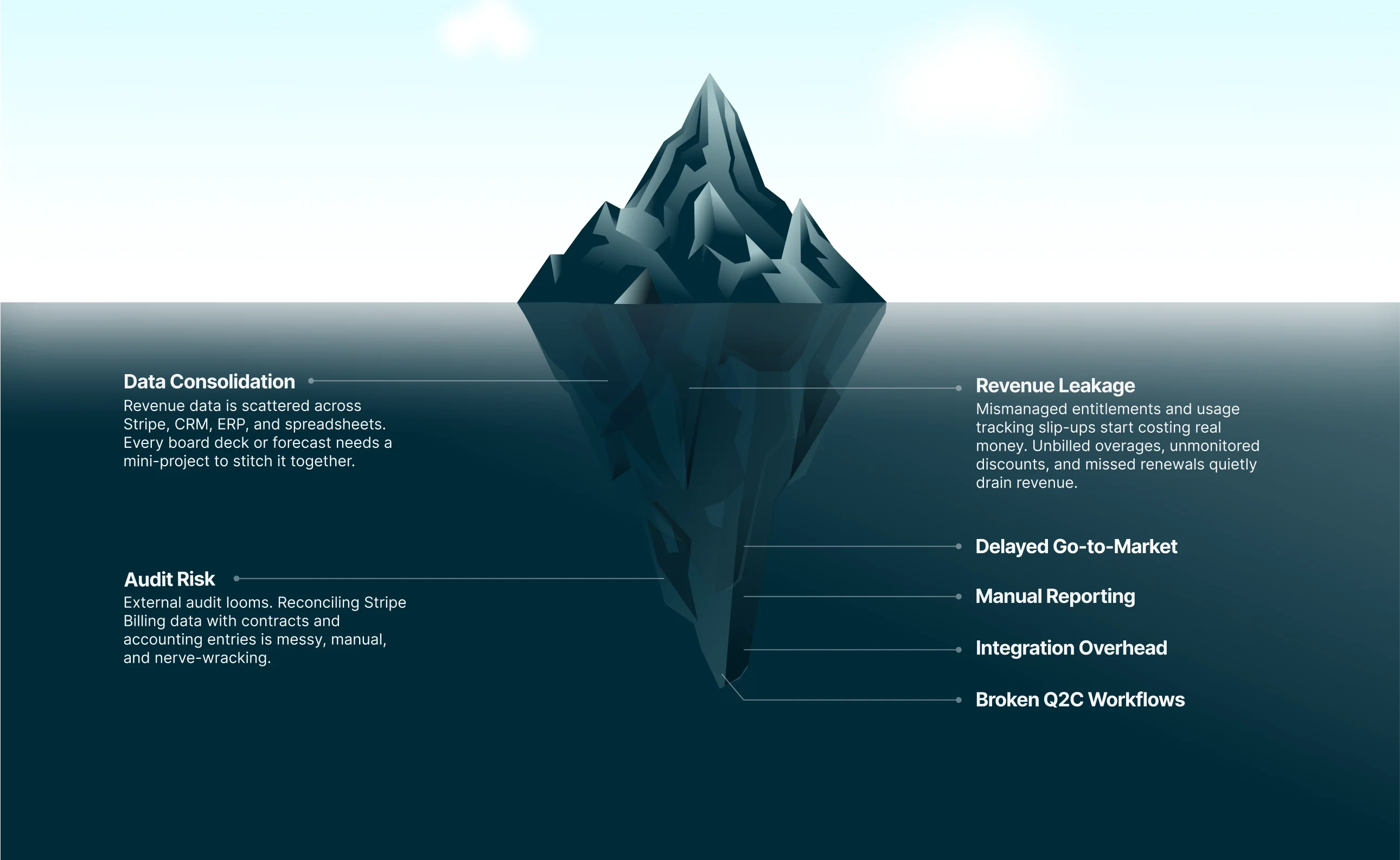
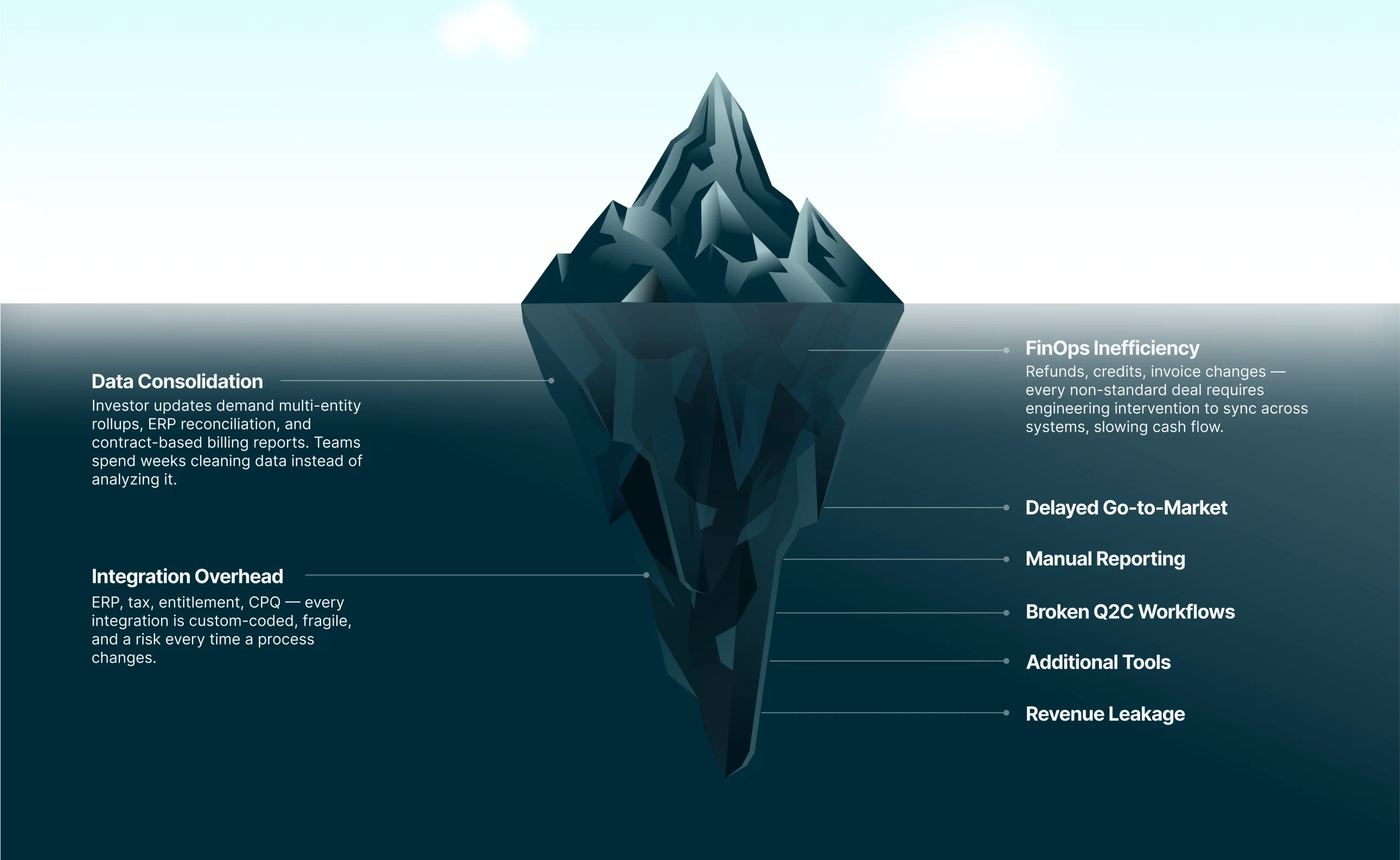
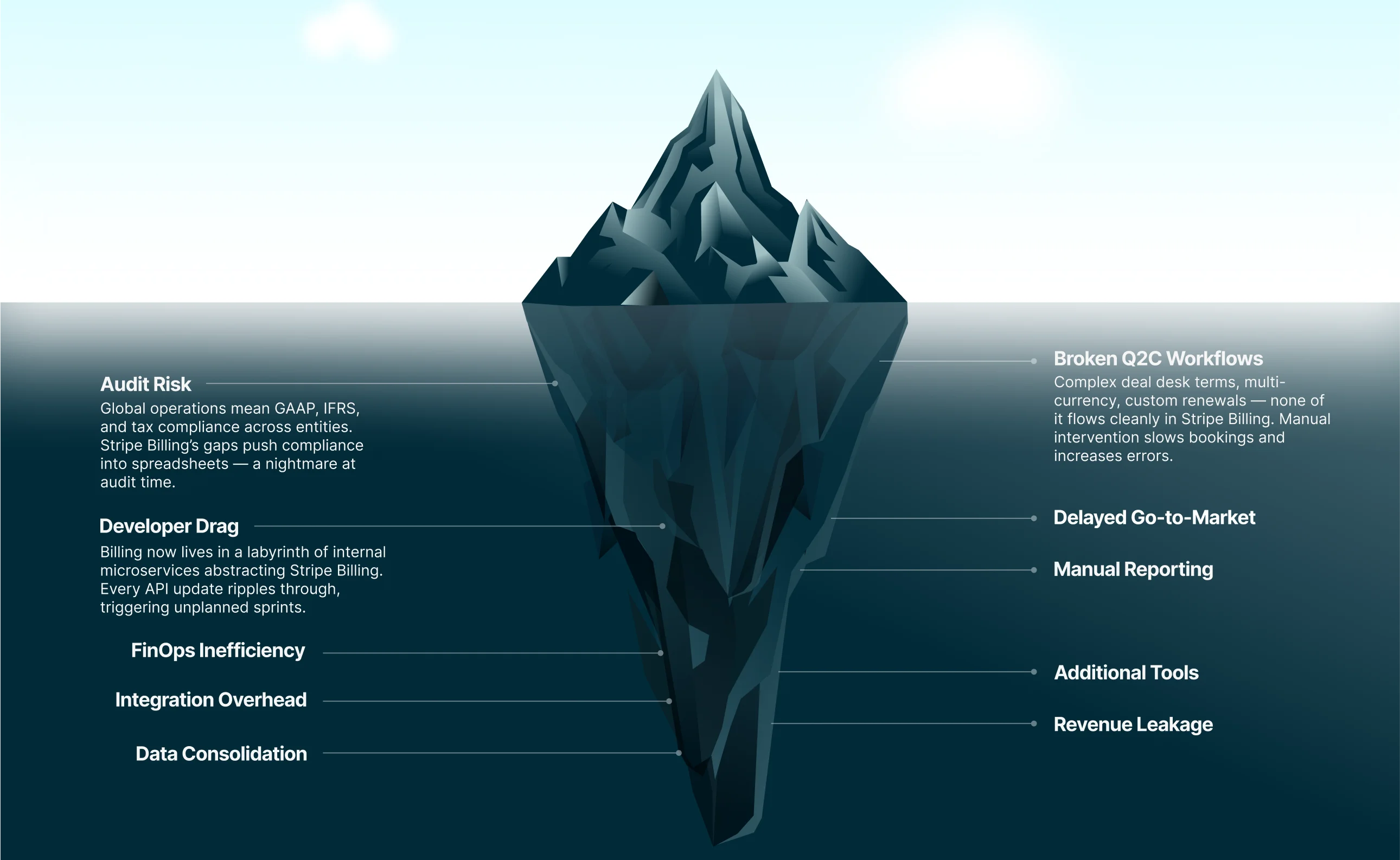
Stripe Billing's Hidden Growth Tax

Stripe Billing may look 'simple' and 'less expensive' to get started. Initial speed advantage becomes technical debt when you go beyond basic subscriptions - costing you fees, developer time, and operational rigor. Why pay a growth tax that gets higher with every success?

$1M Revenue Iceberg
$5M Revenue Iceberg
$20M Revenue Iceberg
$50M Revenue Iceberg
$100M Revenue Iceberg
Key differences

Chargebee vs Stripe Billing

CapabilityChargebeeStripe BillingStripe’s hidden growth tax
Pricing & packagingSupported Launch pricing tests and bundles directly from UI. Works for PLG & sales-assisted.Supported with caveats Discount scheduling or hybrid models require custom development.Delayed GTM; engineering pulled from core product.
Quote-to-cashSupported Native CPQ + HubSpot/Salesforce sync with approval workflows and discount controls.Not supported Basic integrations via third-party connectors. No guardrails for sales deals.~0.76% ARR leakage from rogue quoting and reconciliation errors.
Usage billing & creditsSupported Event-native metering, prepaid credits, and usage + subscriptions on one record.Supported with caveats Usage in Metronome; subscriptions, tax, and RevRec in Stripe. Two record sets every close.Every pricing change made twice across two systems that don’t agree by default.
API & developer experienceSupported Billing logic, entitlements, and RevRec built into APIs. Low engineering effort for maintenance.Supported Fastest initial setup for basic recurring billing. Raw APIs give more control in the beginning.2–10+ engineering FTEs/month to rebuild and maintain (depending on scale).
Revenue recognitionSupported Automated deferred revenue, contract reallocation, and ASC 606 without custom builds.Not supported Basic RevRec. No SSP library or complex deal support. Spreadsheets and SQL only.Prone to errors, misstatements, and penalties.
Reporting & analyticsSupported Native cohort analysis, churn insights, flexible exports — no SQL required.Not supported Raw data dumps require stitching exports or SQL for basic insights.~12–60 hrs/month stitching reports from multiple tools.
Payment gateway flexibilitySupported 30+ gateway integrations for market expansion.Supported with caveats Limited non-Stripe gateways with minimal optimization incentive.No leverage to lower fees or improve auth rates.
Total cost of ownershipSupported Eliminates hidden costs from developer time, tool sprawl, and manual operations.Not supported Low upfront fees masked by engineering overhead plus additional tooling costs.~7% of ARR on top of the 2.9% for Stripe Payments.
Usage architecture

Stripe + Metronome is two systems.

The Metronome acquisition split Stripe’s billing in two — usage, credits, and contracts in Metronome; subscriptions, tax, and RevRec in Stripe. That leaves your team to:

  • Reconcile two record sets at every close
  • Sync usage to subscriptions by hand
  • Make every pricing change twice, in two systems that don’t agree by default

Chargebee is one.

Chargebee runs all of it on one record — meter an event, draw down a credit, invoice it, recognize it, against the same customer and the same catalog:

  • Event ingestion in real time
  • Prepaid credits with a wallet and ledger (grants, top-ups, drawdown)
  • One catalog for usage and subscription products
  • One customer record for metering, credits, invoicing, and RevRec

Built for high-velocity token and API consumption. Nothing to reconcile, because nothing was ever split.

Migration

Zero-risk transition from Stripe Billing

Moving billing feels high-stakes, so we carry the risk. Rated #1 on G2 for Fastest Implementation six years running — we’ve turned complex migrations into a repeatable science.

  • Zero disruption to payments

    Your Stripe tokens, cards, and payment processing stay untouched. We upgrade only the billing layer.

  • Dedicated migration team

    Specialists handle extraction, validation, and import. Straightforward subscriptions migrate in ~4–8 weeks.

  • Pre-launch testing with Time Machine

    Full sandbox validation plus simulation against production data before go-live.

  • Flexible timeline

    Phased rollout (new customers first) or full cutover — your call.

FAQ

Common questions

Get started

Ready to run billing on one record?

Tell us how your billing is set up today. We'll show you exactly what moving to Chargebee looks like, and whether it's worth it for you.

Schedule a demo