Docschargebeedocs

HomeBillingPaymentsRevRecGrowthReveal
Support

Product Updates


  • Release Notes

Getting Started


  • Overview
  • Chargebee Billing Data Centers
  • Object Relationship Model
  • Understanding Sites
  • Developer Resources
  • Chargebee Tech Glossary
  • Articles and FAQ

Implementing Chargebee


  • Implementation Guide
  • Go-live Checklist
  • Articles and FAQ

AI in Chargebee


  • Chargebee Agents
  • Chargebee Copilot
  • Chargebee MCP Server (Model context protocol)

Product Catalog


  • Product Catalog Overview
  • Coupons
  • Articles and FAQ

Subscriptions


  • Working with Subscriptions
  • Billing
  • Orders
  • Articles and FAQ

Customers


  • Managing Customers
  • Account Hierarchy
  • Email Notifications
  • Branding
  • Configure Multiple Languages
  • Articles and FAQ

Invoices, Credit Notes and Quotes


  • Invoices
  • Credit Notes
  • Quotes [Legacy]
  • Transactions
  • Articles and FAQ

Taxes


  • Overview
  • Configuring Taxes
  • Country-specific Taxes
  • Articles and FAQ

Hosted Capabilities


  • Overview
  • Hosted Checkout
  • Hosted Self-Serve Portal
  • Hosted Pages Features
  • Additional Hosted Pages
  • Payment Components
  • Managing payments with ChargebeeJS
  • Mobile-Optimized Hosted Pages
  • Articles and FAQ

Site Configuration


  • Users & Roles
  • Custom Fields & Metadata
  • Mandatory Fields
  • File Attachments & Comments
  • Advanced Filter Options
  • Multicurrency Pricing
  • Multi-decimal Support
  • Configuring Reason Codes
  • Events and Webhooks
  • API Keys
  • Time Zone
  • Time Machine
  • Transfer Configurations
  • Articles and FAQ

Reports and Analytics


  • RevenueStory
  • Home Dashboard
  • Frequently Asked Questions
  • FAQs for Classic Reports Sunset
  • Articles and FAQ

Integrations


  • Sales
  • Customer Support and Success
  • Finance
  • Tax
  • Marketing
  • Stitch
  • Collaboration
  • Contract Management
  • Order Management
  • Mobile Subscriptions (Legacy)
  • Other Integrations
  • Articles and FAQ

Data Privacy & Security


  • Two Factor Authentication
  • SAML Single Sign-On
  • System for Cross-Domain Identity Management (SCIM)
  • EU-GDPR
  • Consent Management
  • Personal Data Management
  • Compliance Certificates
  • HIPAA Guidelines
  • PCI Recommendations and Integration Types
  • Articles and FAQ

Data Operations


  • Bulk Operations
  • Migration
  • Articles and FAQ
  1. Billing
  2. Integrations
  3. Articles and FAQ
  4. HubSpot
  1. Billing
  2. Integrations
  3. Articles and FAQ
  4. HubSpot

How to resolve Chargebee card issues in HubSpot after merging companies

Problem Statement

When two companies are merged in HubSpot, the Chargebee Customer card (from the Quote to Cash with Chargebee integration) may stop displaying customer information. Instead, you see:

This Company isn't linked to a Chargebee Customer.

This occurs even when the Chargebee Customer ID is still populated in the merged company record. The integration card no longer recognizes the link to Chargebee.
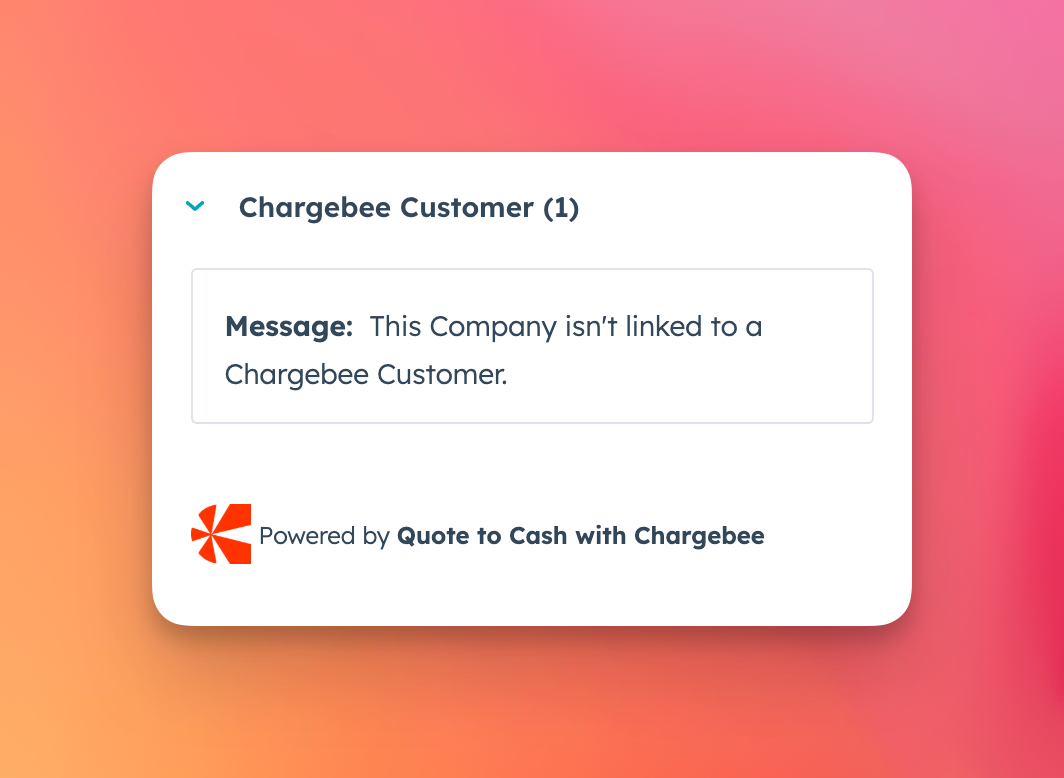
Company not linked to Chargebee Customer message

Solution

This behavior is expected due to how HubSpot handles company merges:

  • When companies are merged, HubSpot creates a new company record.
  • The source companies are consolidated into a new entity.
  • The existing Chargebee–HubSpot link breaks, even though the Customer ID property still appears.

To restore the link, you must re-sync the customer in Chargebee.

Configuration steps

Step 1: Open the HubSpot integration in Chargebee

  1. Go to Chargebee > Apps > HubSpot Integration.

Step 2: Locate the customer in Sync logs

  1. Select the Sync Logs tab.

  2. Search for the relevant Chargebee Customer ID.

Step 3: Re-trigger the sync

  1. Click Redirect Sync for that customer.

  2. Wait for the sync to complete.

Step 4: Verify in HubSpot

  1. Open the merged HubSpot company record.

  2. The Chargebee Customer card should now display correctly and link to the Chargebee customer.

Was this article helpful?