



Set Access Rules Without Code
Token budgets. Model-tier access. Feature entitlements. Custom deal terms. Configure and enforce all of it at runtime, without a code change.
Northwind AI
Enterprise · custom deal
Feature access
Frontier models
Claude · GPT-4o · Gemini
API access
Subscription override
Advanced reports
Not in current tier
Trusted by AI-native startups and enterprises
Entitlement management
Entitlement management is what makes every pricing change reach the product.
Top product companies made 5× more pricing and packaging changes in 2025 than the year before. Every one of those changes has to reach the product and enforce correctly at runtime. AI made that job measurably harder.
Monetization decisions happen at runtime
Credits, model overrides, department quotas, and overage rules: this logic runs at every API call, across thousands of customers simultaneously.
Usage limits are now a contract lever
Sales reps negotiate on tokens, model access, and overage rates. Those terms have to live in the product as enforced parameters from day one, not in a signed PDF.
Every model release is a new entitlement decision
Which plans get access? Shared quota or separate pool? When inference costs drop, does that flow through to customers? Your entitlement layer needs to move at the speed of your roadmap.
AI features are expensive to serve
A vendor without clear usage controls opens themselves to margin risk. A buyer without spend visibility is one runaway workflow away from a surprise bill.
Built for the whole monetization-to-billing flow
Build once. Give every team direct control.
Product, engineering, finance, and go-to-market each act on the same subscription record, in tools built for their context, without filing a ticket.
Measure adoption. Iterate pricing. Ship changes without a ticket.
- ✓Track allocated vs. consumed per feature and per customer in real time
- ✓Offer any feature as a limited-time trial directly from Chargebee
- ✓Retire features from new plans without affecting existing customers
- ✓Grandfather existing customers on current entitlements, or roll changes across all subscriptions
- ✓Run packaging experiments on cohorts and measure adoption before rolling out broadly
Own the architecture. Let everyone else own pricing.
- ✓Let non-engineering teams control feature access, quotas, and limits for any customer
- ✓Keep feature access logic in configuration, not scattered across the codebase
- ✓Maintain version history of every entitlement change, so you always know what changed, when, and for which customer
"We had custom JSON documents for each subscription and our own code to summarize entitlements. With Chargebee, our codebase is much leaner."
Stop revenue leakage from unmonitored entitlements.
- ✓Set trial overrides that expire automatically on the agreed date
- ✓Eliminate end-of-month reconciliation work with automatic overage billing
- ✓Set hard stops on expensive features before a runaway workflow becomes a billing dispute
- ✓Trigger an upgrade prompt before customers hit 100% usage quota
- ✓Eliminate the revenue risk of customers accessing features they've stopped paying for
"Chargebee Entitlements let us activate multiple products under a single subscription, single invoice, and a coordinated renewal process."
Configure custom terms. Turn usage data into expansion signals.
- ✓Grant or modify feature access for specific customers directly from the UI, with no engineering tickets or code deployments
- ✓Override usage limits for each feature at the quote or subscription level
- ✓Extend a customer's usage limit as a goodwill gesture without engineering involvement
- ✓Identify customers approaching their allocation and trigger an upgrade conversation from the same system
- ✓Present allocated vs. actual consumption data and drive expansion deals
"Our customer success and product teams can manage feature provisioning and offer limited-period feature trials without developer dependency."
Why Chargebee
Put entitlements and billing on one record. Every change enforces itself.
Most billing vendors bolt on an entitlement layer. Most entitlement vendors bolt on a billing integration. Chargebee was built so both live on the same data model. This means that a plan change in billing updates what the product enforces, and a usage event that crosses a threshold triggers billing automatically.
| In-house buildAccess logic in application code | Standalone EMS + billingTwo or more platforms for entitlements & billing | Entitlements and billing in one system with a shared data model | |
|---|---|---|---|
| Logic and code | ✗Entangled in application code. Every plan change is a code change and a deployment. Pricing velocity is capped by engineering capacity. | ~Extracted from application code into a dedicated layer. Non-engineering teams get a control interface. Access enforcement works well. | ✓Configuration-driven, on the same data model as billing. Pricing changes apply everywhere with no deployment. |
| Billing relationship | ✗Billing and access live in the same codebase as separate concerns. When a plan changes, both sides need to be updated deliberately. Miss one, and a customer is billed for something they can't access, or accesses something they didn't pay for. | ✗Two systems, each holding part of the commercial record. Works cleanly for fixed plans. With complex usage or hybrid plans, you're coordinating across platforms with no native handoff. | ✓One data model. A usage event that crosses a threshold triggers billing automatically. A plan change in billing updates what the product enforces. No coordination layer needed. |
| Mid-cycle changes and overages | ✗Overages are caught during bill runs (which then become a billing dispute ticket) because there's no runtime consumption tracking connected to billing thresholds. | ✗Plan changes and fixed overages are manageable. Usage-based and hybrid pricing is where it breaks down: the EMS tracks consumption, but true execution of the commercial model depends on how good the billing system is. | ✓Entitlements hold the included usage threshold and monitor consumption in real time. When a customer crosses it, overage billing kicks in. An annual contract can bill for overages monthly without manual effort. |
| Custom enterprise deals | ✗Custom limits get hardcoded as exceptions. As contracts get amended more frequently, with usage-based terms and top-ups, the exceptions accumulate with no central view of who has what. Unmonitored custom entitlements become direct revenue leakage. | ✗Deal terms configured in the EMS, billing updated separately. As amendments increase, the overhead of keeping both current compounds, and gaps between what was agreed and what was billed widen quietly. | ✓Custom limits set once in Chargebee flow into both the product and billing records. Every amendment updates both sides. You always have a current view of what each customer is entitled to and what they owe for it. |
| AI and runtime pricing | ✗Token limits, model-tier access, and overage rules are hardcoded in application logic. When inference costs change or a new model tier launches, each adjustment is a code deployment. As agent complexity grows, the exceptions compound. | ~Access rules can update independently of billing. But concurrent agent entitlement checks, per-model usage pools, and overage enforcement depend on how deeply the EMS integrates with metering. Complex AI pricing typically requires custom implementation on both sides. | ✓Feature access, usage quotas, and credit limits are configurable and operate on the same data model as billing. When inference costs change or a new model tier launches, access rules update in the catalog without code deployments. |
| Control for non-technical teams | ✗Finance and GTM can read reports but can't act on the layer directly. In-house admin pages offer some basic actions, but revenue opportunities slip by without purpose-built usage monitoring and alerting. | ~Product and CS teams can manage feature access independently. But with no single system that owns the monetization context, capturing revenue signals requires additional engineering capacity. | ✓Every team works from the same commercial record, with tools built for their context. CS extends a trial, Finance audits consumption, Sales configures a custom deal, and Product gets notified on top users per feature, all from the same system. |
One platform
Entitlements runs on the full
Chargebee stack.
Feature access is one layer. The same record powers how you bill, quote, and grow, so your commercial model stays consistent from sign-up to renewal.
Credits, usage, and hybrid pricing
Token metering, credit drawdown, and usage overages, on the same record entitlements enforce. Commitment plus consumption on one contract, billed without reconciliation.
Explore Billing →CPQQuote pilots, ramps, and credits in one doc
Custom limits and discount floors enforced automatically. When the deal signs, the subscription and its entitlements provision without manual entry.
Explore CPQ →GrowthTurn usage into expansion
Test prices, lift renewals, and intercept cancellations, measured in ARR, not clicks. Surface accounts nearing their limits and trigger the upgrade.
Explore Growth →Join the AI companies enforcing pricing at runtime with Chargebee.

At Kommunicate AI, our move to a hybrid pricing model from a flat seat based one was driven by a need to increase our profitability and average revenue per customer. Chargebee has been a strategic partner helping us achieve all these objectives.

Entitlement management, answered
Your commercial terms don't need a second system to come alive.
Entitlements, billing, and usage on one record. Configure, enforce, and iterate without engineering involvement every time pricing changes.
Related reading

5 warning signs your in-house entitlement management is failing
Read the checklist →
How to transition to usage-based pricing
Read the guide →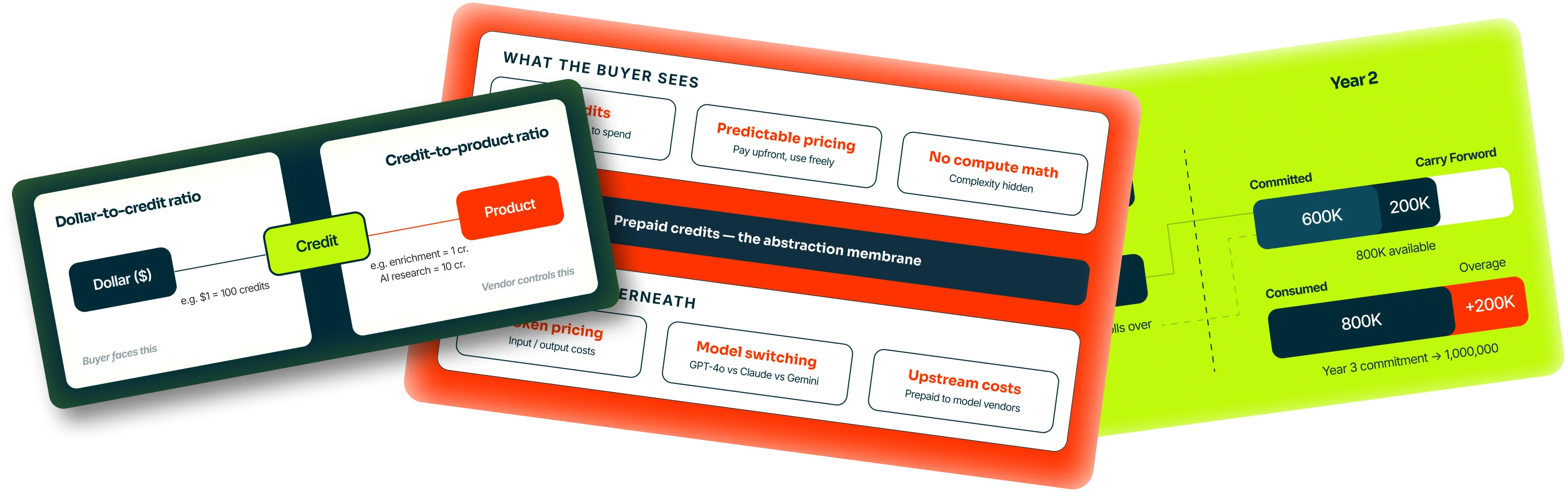
The prepaid credits guide
Read the guide →Pricing Labs
AI Monetization 101
Teardowns, playbooks, and pricing research for AI and SaaS teams. Everything you need to package, price, and protect margin as agents scale.