The Definitive Guide to Prepaid Credits
for AI & SaaS Companies

Featuring insights from Ulrik Lehrskov-Schmidt, Founder of Willingness2Pay, a specialized advisory firm focused on complex B2B software pricing for over a decade.

Who This Guide Is For

When it comes to pricing and packaging, credits solve a real problem. They also create about a dozen new ones, and most teams find them in the wrong order.

This guide is for product, pricing, and finance practitioners deciding whether to adopt credit-based pricing or trying to refine a credit system that needs work.

If you're in either place, you've probably asked some version of these questions:

  • Should one credit equal one action, or represent a dollar amount?
  • Should credits roll over or expire?
  • What happens when a customer runs out of credits mid-quarter?
  • How do I set prices when my underlying model costs change every few months?
  • How do I get procurement to agree to a pricing model they've never seen before?

This guide answers all of them. We co-write it with Ulrik Lehrskov-Schmidt, Senior Pricing Advisor and CEO of Willingness2Pay. He's spent over a decade designing complex software pricing, including credit systems for companies ranging from early-stage startups to publicly traded enterprises. We've combined his frameworks with what we see working and breaking across thousands of AI and SaaS companies at Chargebee every day.

The guide follows a decision sequence: why credits took off (and whether they're right for you), how to price them, how to design the system, how to sell and grow with it, and the kind of infrastructure you need to support it all.

1. Why Credits Took Over (and Whether They're Right for You)

Credit-based pricing took off because the economics of software changed, and every alternative proved inadequate.

Seat-based business models couldn't absorb variable compute costs. Flat fees left margins on the table. Postpaid usage created cash flow mismatches that nobody could sustain. Credits solved all three problems at once: usage-based enough to reflect real costs, prepaid enough to fund them, and abstract enough to give flexibility to both the customers and vendors.

The result is visible across the industry. Figma, Salesforce, HubSpot, monday.com, and PostHog have all introduced credits for AI features. Clay pioneered credits as its core unit of consumption and hit $100M ARR. OpenAI and Anthropic have relied on prepaid token consumption from the start.

Four structural forces explain why this model has become the default for AI monetization.

#1 Your infrastructure is now customer-facing

In traditional SaaS, infrastructure sat in the background. The cost of serving one more user was low enough that pricing could be set almost entirely around value and segmentation. AI changed that. In AI products, infrastructure directly shapes the customer experience. A better model, a larger context window, or more agentic behavior improves the product, but also increases cost. Every prompt, every generation, every workflow consumes real compute.

That made AI companies look less like classic SaaS vendors and more like businesses reselling compute through software. So usage-based pricing became necessary, but postpaid billing created a cash flow problem: many AI companies were themselves paying upstream model vendors on prepaid or usage-linked terms. Money was going out before it came in.

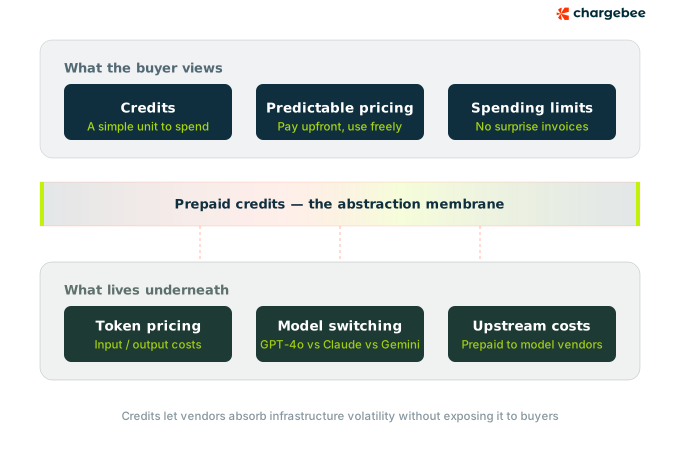
Prepaid credits solved this mismatch in two ways: the prepaid aspect preserves usage-based pricing while pulling payment forward, and the credit or virtual currency aspect creates an abstraction layer that simplifies underlying compute complexity for the buyer.

Credits let vendors absorb infrastructure volatility without exposing it to buyers

Clay is a strong illustration. It combines data from 150+ providers and runs AI agents across workflows, with real variable cost attached to each action. A flat seat model would have made margins unpredictable. Credits gave Clay a cleaner way to map price to cost while keeping the product flexible for customers.

#2 No one knows how they’ll use AI, including your customers

Traditional pricing works when demand is predictable. Whether it's seats, storage, or API calls, buyers can estimate their needs to a fair degree, and variances are small. AI usage has no such predictability, and in two distinct ways that compound each other.

The first is across users. When a company rolls out an AI tool to 10,000 employees, 50% might never touch it. Meanwhile, 200 power users might consume more than the entire rest of the organization combined.

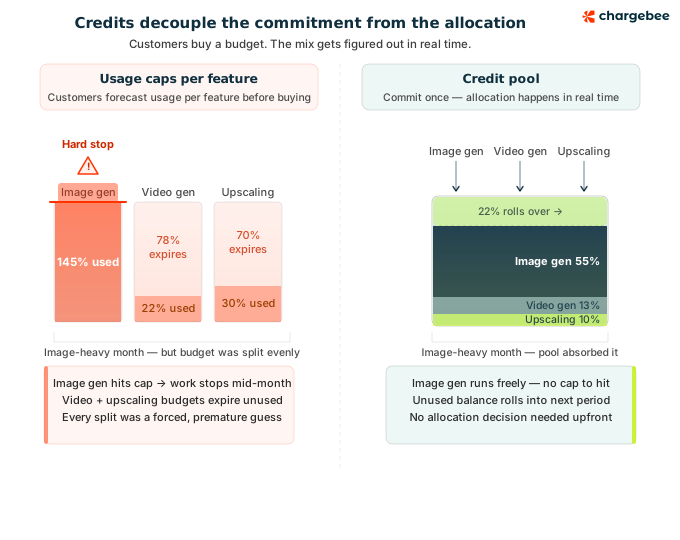
The second is across actions. Even within a single customer account, nobody can tell you upfront how many images versus videos they'll generate, how many enrichments versus AI research tasks they'll run, or whether they'll lean into one feature heavily and barely touch another. A customer buying a design tool in January genuinely doesn't know if February will be all images or all video. The mix shifts as teams discover what the product can do.

This breaks conventional models. Per-feature pricing forces customers to bet on a consumption mix they can't predict. Rigid upfront commits feel risky when neither side knows where usage will land. A multi-tier structure that prices each action type separately multiplies the uncertainty. Every tier becomes a guess.

Credits solve this because a shared pool of currency naturally absorbs both types of variance. Customers commit their spend upfront, but they don't have to predict how it gets allocated across users or actions. If this month is heavy on video and light on images, the credits flex. If one team burns through the pool while another barely touches it, the account still gets value. They bought a budget, not a forecast.

Figma saw this firsthand: when they introduced AI credits in late 2025, they deliberately didn't enforce limits for three months. They let users experiment freely, collected real consumption data, and discovered a power-law pattern: 75% of high-value customers were using AI weekly, but a small subset consumed far more than any preset tier would have predicted. That data shaped their credit tiers when enforcement began.

Credits decouple the commitment from the allocation

#3 Prepaid credits are also a fundraising tool

For AI startups heading toward a funding round, the billing model itself becomes a fundraising asset.

"If you have a commit model for $500K worth of credits, you can actually take that to the bank. In this case, the VCs. If you've just given customers a line of credit and they pay after the fact, you can't. You just have a signup, and they might not use it a lot."

- Ulrik Lehrskov-Schmidt, Senior Pricing Advisor & CEO, Willingness2Pay

Besides offering better pricing levers, prepaid credits can improve cash flow, make demand more legible, and give companies a stronger story at the term sheet table.

#4 Buyers needed a way to say yes

The three forces above explain why vendors moved to credits. But credits only took off because buyers accepted them, and that wasn't inevitable.

A postpaid usage model exposes customers to open-ended liability: the bill at month-end is whatever it is, but finance teams need a model they can approve with confidence. Credits convert an unpredictable meter into a pre-approved budget with a known ceiling. Flexibility in how the budget gets consumed, predictability in what it will cost. Vendors get cash upfront. Buyers get procurement simplicity. That alignment is why credits spread so fast.

Key Takeaway:
Credits work when your product has real variable costs per action, unpredictable usage patterns, and a multi-feature catalog that benefits from a unified currency. If two of those three are true, credits are likely your long-term model. If none of them are true, you may just be adding complexity without a reason.

2. How to Price a Credit (Without Defaulting to Cost-Plus)

You've decided credits are the right model. Now comes the question that trips up almost every team: what should one credit be worth?

Most companies answer it by looking inward: at model costs, margins, and markup. That's an understandable starting point, but it's only a floor. The ceiling is set somewhere else entirely: in your customer's world, at the point where your product touches their revenue. To find it, you need to follow the value chain.

The spectrum from cost to value

Every business runs a value chain: a sequence of steps from raw input to revenue. The framework for credit pricing runs along it:

Horizontal companies serve every use case and every industry. They price on the compute: tokens in, tokens out. OpenAI can't price their foundation models by outcome because they don't know what you're using the model for, let alone whether it worked.

Vertical companies apply AI to a specific outcome for a specific customer type. Going vertical means you can see your customer's value chain clearly and price closer to outcomes. Phrase, for example, serves translation and localization teams specifically. Its virtual currency (TMS) maps to words translated, a unit the customers already track and budget around. Artlist serves video creators; its credits map to assets downloaded, tied directly to production output. In both cases, the pricing metric matches the moment of value delivery for that specific customer type.

The further right you can anchor your credits on the value chain, the more pricing power you have. But it requires owning a specific, measurable moment in your customer's workflow.

Ask yourself: Which step in my customer's value chain do we actually own? What metric do they already use to measure success at that step? When your credit maps to a unit they already track, the pricing conversation transforms.

How Clay rebuilt its pricing around value, not cost

Clay's March 2026 pricing overhaul is one of the clearest real-world examples of deliberately moving a credit model from left to right on the value chain.

In 2022, Clay was primarily a data marketplace. Credits mapped directly to the cost of third-party data: a mobile phone lookup could cost 2 to 25 credits, depending on the provider. Credits = markup on inputs.

As Clay evolved into a full workflow automation platform (AI research, CRM enrichment, multi-step outbound, intent signals), the original pricing assumptions didn’t hold up. Customers buying mainly data thought Clay was expensive. Customers using the orchestration layer thought it was a bargain. One credit was trying to represent two fundamentally different types of value.

The overhaul split the model into two:

  • Data Credits now cover third-party data at a 50–90% reduction, roughly comparable to going direct. For AI models, 80% have flat fixed credit costs; the top 20% of advanced models use variable pricing at zero markup, meaning customers pay exactly what Clay pays the provider.
  • Actions are a new unit measuring platform work: enrichments, AI research, CRM syncs, and exports. Clay says 90% of customers will never hit their 'actions' limit.

Clay's pricing memo acknowledged the potential near-term revenue hit. Their bet: making the cost layer cheap drives adoption on the value layer, where long-term moat and margin live.

Same dollar amount, completely different reaction

Willingness to pay is the dollar amount a customer would part with. Expectation to pay is the model they consider fair for what you do. You need both, and the distinction matters.

Consider an AI sales tool that generates leads worth $1,000 each. Charge $10 per lead, and customers typically say, "reasonable." Charge "1% of revenue" instead, and the same customers would push back, even though the math is identical. Because revenue-based pricing feels like you're claiming credit for the entire revenue process, not just the lead you delivered.

Your pricing metric should match the scope of what you do. Customers accept pricing tied to the outcome you deliver. Pricing that reaches beyond your contribution breaks that acceptance.

How to set the credit-to-dollar ratio

The ratio is governed by the smallest possible purchase in your catalog. One credit must equal one unit of the cheapest action you sell. Nobody prices in fractions of a credit (yet). From there:

  1. Identify the cheapest action (e.g., one image, or 1,000 API calls) → that's 1 credit
  2. Price everything else as multiples of that base
  3. Bundle into clean purchase tiers ($5K, $10K, $50K)
Key Takeaway:
The pricing question isn't "what does this cost me?". It's "what step in my customer's value chain do I own, and what is that step worth to them?" Horizontal companies will always price on inputs. Vertical companies that can measure outcomes have room to charge multiples more for the same underlying compute.

3. The Design Decisions That Make or Break a Credit System

Your pricing strategy is set. What breaks next is the system behind it: what customers can buy, how the internal economy functions, and the policies that govern the customer experience.

One thing or many: Your first architecture decision

Can customers buy one type of thing with their credits, or many?

  • Single-purchase systems let one credit buy one output. Audible is the clearest example: one credit, one audiobook, no math required. This works well for B2C or prosumer products with a single core offering.
  • Multi-purchase systems let one pool buy many actions at different rates (API calls, image generation, data enrichment, workflow runs), as in OpenAI or Clay.

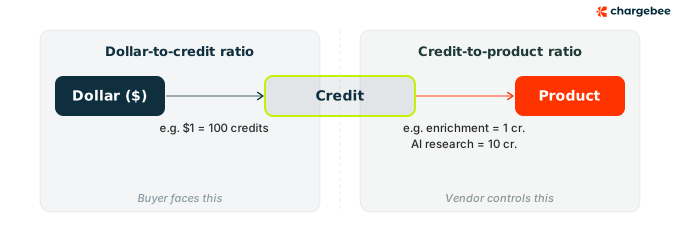
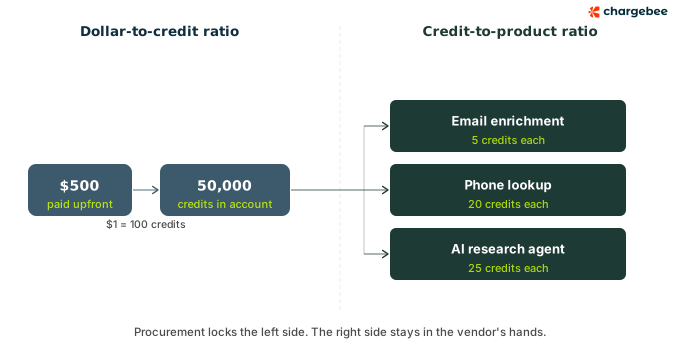
The design implication is important: in single-purchase systems, simplicity lives on the credit-to-product side (one credit = one audiobook). In multi-purchase systems, simplicity must live on the dollar-to-credit side ($1 = 100 credits), because the credit-to-product side is inherently complex across a multi-feature catalog. If both sides are complex, buyers stall, and sales cycles stretch.
This is also a forward-looking decision. If you know you'll have three more features to monetize next year, design a multi-purchase architecture now rather than rebuilding later.

Dollar-to-credit ratio vs credit-to-product ratio

Credits let you run every pricing model at once

In a multi-purchase credit system, something changes in the commercial relationship: the purchase decision moves upstream, and everything after it becomes allocation.

Outside a prepaid credit system, every pricing model creates its own friction. Flat fees trigger budget approvals, usage charges generate invoice disputes, and license expansions require renegotiation. Inside a credit economy, your customer has already paid. They're spending something they own. This means you can run every available pricing model within the same system, with no new purchase friction:

  • Flat fee: "Unlock this feature for 5,000 credits/year" — no new invoice or approval cycle
  • Per-license: "100 credits per user," charged against an account that's already funded
  • Usage-based: "3 credits per action," variable consumption from a prepaid pool

The case against dollar-denominated credits

Dollar-denominated credits create two problems that abstract credits avoid entirely.

First, depending on your product design and jurisdiction, certain credit features, particularly the ability to withdraw credits as cash or transfer them between accounts, may attract financial services scrutiny. A credits-only system where customers spend but cannot withdraw or transfer is generally outside that territory, but we'd recommend legal review before enabling either. Credits, as a platform-specific virtual currency, keep you well clear of this by default.

Second, dollar-denominated credits break your own commercial math. When you offer volume discounts, you're essentially selling $1M worth of credits for $700K. If credits are abstract units, that's a clean pricing decision your finance team can recognize straightforwardly. But if those credits are literally dollars sitting in a customer account, you now have a customer who sees $1M on their dashboard while your books show $700K of revenue. Every discount you offer widens that gap, and revenue recognition becomes a compounding problem your finance team and auditors will have to untangle manually.

What happens at both ends of consumption

Every customer lands somewhere on a spectrum: they either consume fewer credits than they bought, or more. Your policies need to handle both ends without creating anxiety at either one.

When customers underuse

"The biggest mistake companies make with credits is not allowing them to roll over. If credits expire at the end of each period, the system is functionally identical to a license. You're just calling it credits."

- Ulrik Lehrskov-Schmidt, Senior Pricing Advisor & CEO, Willingness2Pay

Your credit rollover policy has a direct implication on your sales cycles:

Rollover policyCustomer mental modelCommercial outcome
Full rolloverLow risk. I'll use them next year if I don't this year.Shorter sales cycle
Customer buys freely — sometimes over-purchases — but easier decisions mean a faster close.
No rolloverI could lose these. I'll buy only what I'm sure I'll use.Longer sales cycle
Customer negotiates harder, buys less. Sales cycle becomes longer and more friction-heavy.
Partial rolloverI might lose some anyway. Why buy more than I need?Minimal upside
Full downside of no rollover — none of the goodwill of a full one.

The usual objection to rollovers comes from the CFO, as unused credits become a balance sheet liability. The fix is controlling how long credits can roll over, not whether they do:

  • Annual contracts: allow one rollover. Maximum liability caps at 24 months.
  • Monthly plans: allow 2–3 months. Credits bought in January expire by March.
  • Credits should follow FIFO: oldest credits consumed first, so balances stay naturally current.

Beyond purchase psychology, rollovers are a retention mechanism in disguise. Elena Verna, who leads growth at Lovable, has written about how rollover credits actively reduced churn: when users see accumulated credits in their account, they return to use them before canceling, and once they start building again, many don't leave. Lovable extends this logic by giving users 5 free daily credits on top of their monthly credit allowance, keeping them engaged on the platform.

When customers overuse

Power users burning through credits before the period ends is a good problem because it signals genuine adoption. But how you handle it determines whether it becomes a revenue opportunity or a customer experience failure.

Start by notifying users early that they're approaching their limit. Track credit consumption (burndown) in real time and alert customers at 50%, 80%, and 95%. Don't wait until they hit zero.

  • Enterprise contracts: Allow 10–20% overage above the annual commitment. Invoice the difference at renewal at the same rate.
  • Self-serve: Allow a short grace period, charge the card on file automatically, and upgrade the subscription to match actual consumption.

Per-seat or pooled: How to allocate credits across your customer base

Credit allocation per seat makes sense when the consumption is meant to signal tier differentiation and drive upgrades. But for most products, pooled is the better default, and a real example shows why.

Lehrskov-Schmidt studied a company with 160,000 users on AI credits. Usage followed a sharp 80/20 pattern: 50% consumed zero credits, and roughly 200 users appeared to do nothing but hit the AI button all day. Per-user allocation would have throttled those power users immediately, suppressing both the demand signal and the monetization opportunity. Pooled credits let them burn through volume the majority wasn't using, and expansion happened at the account level ("your team needs more credits") rather than the individual level ("Bob, slow down").

Key Takeaway:
Ensure every policy you design around credits creates a pull toward using the product. If a policy creates anxiety around consumption, it's working against you.

4. How to Sell, Renew, and Grow With Credits

A credit system nobody buys is just an accounting exercise. This chapter is about getting customers to commit, renew on autopilot, and expand over time.

The lowest-friction way to add credits to an existing product

Customers don't commit to a new currency until they've seen it deliver something real. The goal of your first motion is to get them to that moment before the pricing conversation even begins.

Lehrskov-Schmidt calls this the utility model. Think of it like electricity in a house: it's already installed, you don't pay until you turn it on, and the first thing you do is flip a switch to test if it works. The approach has three steps:

  1. Embed AI directly in the product with no separate purchase flow. Customers shouldn't have to go looking for it.
  2. Include a free allowance, enough to seed real behavior without requiring budget approval.
  3. Convert at the consumption wall. When a customer hits the limit, the account team reaches out, or the product surfaces a self-serve upgrade flow. By that point, the customer already knows the feature works.

The sequencing matters here. You're not asking customers to bet on potential value. You're letting them discover actual value, then asking them to pay for it. Figma followed this approach: AI credits included with every seat, three months of free experimentation before enforcement, and credit purchases only introduced after they had hard consumption data. By enforcement day, 75% of high-value customers were already using AI features weekly.

The renewal problem with credits (and a structural fix)

Credit renewal negotiations are essentially two parties arguing about a number neither of them can predict with confidence. The customer wants to commit to less. The sales rep wants them to commit to more. The whole conversation consumes a disproportionate amount of sales resources for what should be a routine transaction.

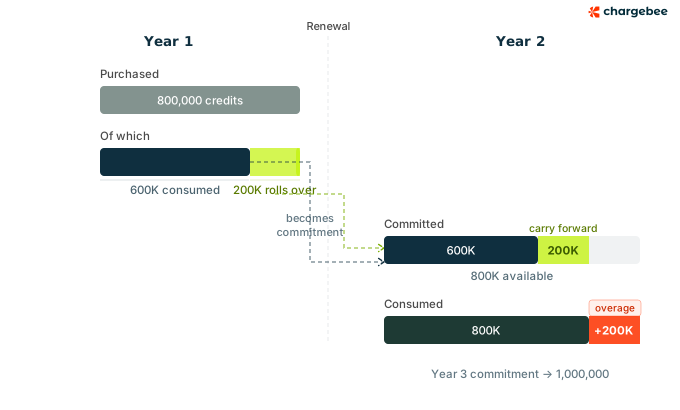
The mechanism that dissolves this tension is what Lehrskov-Schmidt calls transposed commitment: the usage from the previous period becomes the commitment for the next.

Say a customer buys 800,000 credits in year one, consumes 600,000, and rolls over 200,000 into year two. Their renewal commitment for year two is 600,000, what they actually used, not what they bought. If they consumed a million credits in year two, including 200,000 of overage, that becomes the baseline for year three.

Transposed commitment: Year 1 usage becomes Year 2 commitment

With this approach, the renewal conversation shifts from a negotiation to a data review. The number on the table isn't what your sales rep thinks the customer should buy. It's what the customer already demonstrated they need. That's a much easier conversation for everyone. For self-serve, it's even simpler: credit card on file, subscription auto-adjusts to consumption.

How to give customers price certainty while keeping your pricing flexible

Enterprise procurement teams want to lock prices for years. But AI products change at minimum every few months. Credits give you a structural way to offer both at once, if you understand the two exchange rates at play.

When a customer buys credits, two ratios govern what they actually get:

  1. Dollar-to-credit ratio: what they pay per credit
  2. Credit-to-product ratio: what each action costs in credits

Most procurement teams only control the first. The second (how many credits each feature or action consumes) typically remains at the vendor's discretion.

Here's what that means in practice. Consider a sales intelligence platform that charges 5 credits per email enrichment, 20 credits per phone lookup, and 25 credits per AI research query, at $1 per 100 credits. The vendor ships a more capable AI research model and adjusts the credit cost from 25 to 40 credits per query. The contract is untouched, the dollar-to-credit rate hasn't moved, but the effective price of an AI research query has risen, reflecting genuinely improved capability.

"Vendors are largely underutilizing this. It is such a powerful pricing lever, and this window is going to close relatively fast."

- Ulrik Lehrskov-Schmidt, Senior Pricing Advisor & CEO, Willingness2Pay

When you adjust the credit-to-product ratio, give customers a real choice: stay on the old model at the old rate, or move to the improved model at the new rate. This lever only stays powerful as long as customers trust you with it.

Procurement locks the left side. The right side stays in the vendor's hands.

Rethinking sales compensation for credits

Credit models don't fit neatly into either of the two comp structures sales teams know: upfront commission on a license close, or consumption-linked commission in a usage model. Credits are both, and comp should reflect that.

The approach Lehrskov-Schmidt recommends treats the credit commit and actual consumption as two separate commission events, because they represent two different things: the rep's ability to land a deal, and the customer's willingness to use the product.

At close, the rep earns commission on a portion of the committed amount, typically 50 to 80%. Not the full commit, because the customer hasn't consumed anything yet. If a rep closes a $1M credit package, they earn commission on $600K to $800K upfront. The rest is held back.

At year-end, consumption fills in the picture. If the customer used less than the commit, the rep earns only on what was consumed — some of that upfront commission effectively claws back. If they blew past the commit, the rep gets paid on the overage on top of what they already earned. The money follows the usage, not the promise.

This structure does three things: it penalizes overselling, rewards landing genuinely high-usage customers, and keeps reps invested well past close, driving stronger relationships and longer tenure.

Key Takeaway:
Most credit renewal battles are self-inflicted. Anchor commitment to historical usage, align sales comp to actual consumption, and keep your pricing levers inside the credit system — and the conversation shifts from "what do you think you'll need next year?" to "here's what you used."

5. The Operational Reality of Credits

Most companies discover how operationally demanding credits are after they've already deployed them. By then, the problems are customer-facing.

This chapter covers what your customers need from your system, why it's harder to deliver than it looks, and what your infrastructure needs to support it all.

What a well-run credit system looks like to your customers

Credits are a virtual currency, and virtual currencies run on trust. When a customer commits $500,000 upfront to a balance they can't touch or transfer, they're betting on your system being accurate, transparent, and fair. That trust is earned through what your product shows them every day. Three things determine whether customers feel in control of what they bought or anxious about it.

1. Measure (looking backward):
Real-time credit balance, spend broken down by feature or action type, and an audit trail that lets you answer any consumption question without going back and forth with your engineering team. When a customer has to email support to ask how many credits they have left, your system has already failed.
2. Predict (looking forward):
At the current consumption rate, when will credits run out? What's the projected dollar spend through the end of the period? The best implementations go further and translate consumption into forward-looking dollar projections. "At this rate, you'll need an additional $21,000 before your renewal" is a sentence a CFO can act on.
3. Control (managing spend):
Who gets notified at 50%, 80%, and 95% consumption? Who can approve additional purchases or authorize overages? CFOs aren't afraid of high usage; they're afraid of high usage that happened without their knowledge.

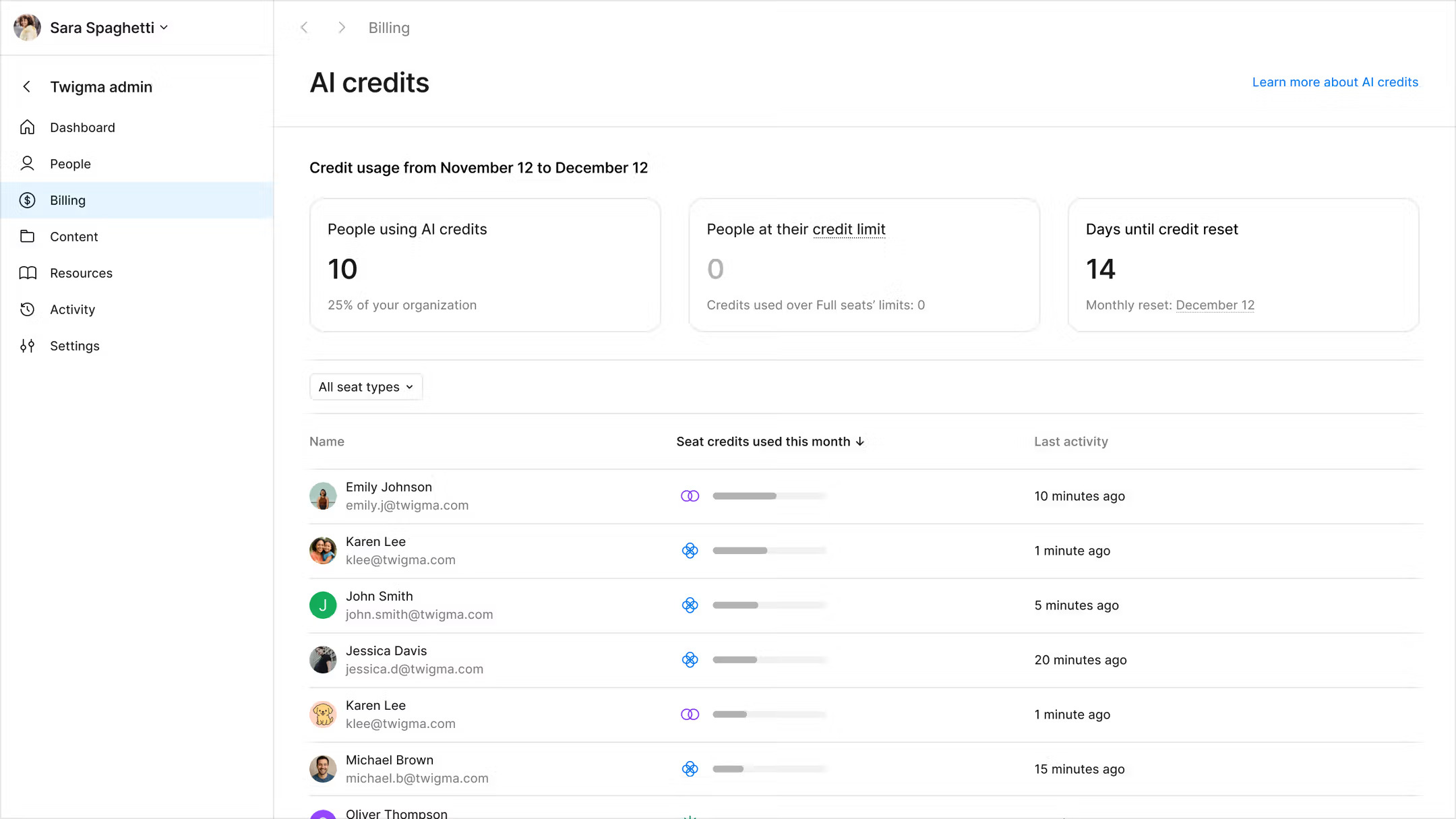
Figma's billing dashboard is a clean example of this done right. Admins see how many users are actively consuming AI credits, who're at their limit, and how many days until the next reset, all without contacting support or pulling a report.

Figma's billing dashboard for AI credits

Why it’s harder to build than it looks

Credits touch every layer of your commercial operation: from how deals are quoted to how revenue is recognized to what customers see in their dashboards. The infrastructure behind them has to be designed end-to-end, not bolted together from tools that weren't built to talk to each other.

When any piece breaks, customers notice immediately. It's their money. Trust in a virtual currency is the product.

Metering: Traditional billing platforms process thousands of recurring billing events per day. Credit systems require infrastructure that handles millions continuously, so that every API call, every generation, and every agent action gets ingested, de-duplicated, and applied to the right credit block without dropping a single event or introducing lag. Most teams discover this mismatch after launch.

The credit ledger: A basic ledger sounds simple: add credits when purchased, subtract when consumed. In practice, it needs to handle multiple credit blocks, FIFO expiry logic, cost basis tracking, mid-period top-ups, and overage balances. Your ledger is your source of truth. If it can't answer exactly how many credits a customer has at any moment, your invoices, portal, and renewal conversations rest on uncertain ground.

Revenue recognition: When a customer buys credits, your business receives cash, but you haven't yet earned the revenue. Those credits sit as a liability until consumed, and under ASC 606, you need to track this with precision. Rollovers extend that liability window: allow credits to roll over once on annual contracts, and your deferred revenue window stretches to 24 months. Free and paid credits are recognized differently, with promotional credits potentially carrying a contra-revenue treatment. Get the recognition policy agreed with your finance team and auditors before you go live, not after.

The full revenue lifecycle: A credit ledger and a pricing tool are necessary but not sufficient. Credits need to flow correctly from CPQ through billing through revenue recognition. Point solutions leave you stitching these pieces together manually, and every pricing change breaks the stitching somewhere.

Most teams try to solve this by stitching together a billing platform, a separate CPQ tool, and a custom-built ledger. This approach works until it doesn't. Usually, at the moment a customer questions an invoice, your finance team needs to close the quarter clean, or you're rolling out a new pricing tier, and you realize the change lives in three different systems.

We built Chargebee for exactly this. Credit grants, real-time metering, ledger management, revenue recognition, and the customer-facing consumption dashboard are one connected system, not four tools talking to each other. When your pricing changes, it propagates. When a customer asks how many credits they have, the answer is instant. When your auditors ask about deferred revenue, the ledger answers.

That's what a credit system looks like when it's built to scale.

Key Takeaway:
Credits introduce a level of operational complexity that most billing infrastructure wasn't built for. As you scale, the gaps show up everywhere: metering errors, ledger inconsistencies, revenue recognition edge cases, renewal conversations that should be automatic but aren't. The right platform runs credits alongside your existing revenue models while preserving the business context your finance, sales, and product teams all depend on.

How to know if your credit-based pricing is working

The simplest test: are you growing?

A working credit system gets out of the way. Customers buy without friction, use without anxiety, and renew without a fight. When growth stalls, the pricing model is often quietly to blame. Friction accumulates in ways that are hard to see from the inside until a customer tells you, or doesn't renew.

Failure modeSymptomFix
Too complex for the price pointLong sales cycles on low-ticket productsSimplify
Simplify, or switch to a flat model
Not generous enoughHigh friction at purchase, low adoptionExtend
Extend rollover window, add free tier
A license in disguiseNo rollover, annual renegotiation, zero flexibilityRedesign
Redesign around actual usage data

Where Credits Go From Here

The structural forces that made credits necessary aren't going away. Falling compute costs are driving higher usage, more agents, more actions, and more complex workflows. As a result, total AI consumption continues to outpace declines in unit cost.

What's changing is the sophistication of buyers and operators. Procurement teams are evaluating how credits map to real product value, not just the headline conversion rate. Customers are paying closer attention to consumption, and finance teams are increasingly comfortable with deferred revenue mechanics. Opaque systems with unclear pricing, confusing conversion logic, or punitive rollover policies are becoming harder to justify.

Pricing power comes from trust. Companies that get credits right create enough confidence for customers to commit and expand over time without constant renegotiation. That trust shows up in faster sales cycles, smoother renewals, and growth driven by actual usage.

Internally, well-designed credits create alignment across teams. Product can evolve pricing and learn faster from the market. Engineering can enable other teams to move independently without having to build or maintain multiple internal services. Finance can close cleanly, and GTM can anchor renewals in consumption data rather than negotiation.

When credits work, they're invisible. Your customers stop thinking about billing and start thinking about what they can build.

Ready to scale your credit-based pricing?
See how AI leaders use Chargebee to automate complex billing and focus on innovation.

About Willingness to Pay

Willingness to Pay has helped 200+ B2B software companies build pricing systems that scale: from outcome-based monetization to transparent packaging, usage-aware billing, and price changes that land safely. We combine customer insight, structured pricing logic, and scalable execution to help teams raise prices, expand ACV, accelerate deals, and align the entire company around how value is priced and delivered.

About Chargebee

Chargebee is a leading provider of billing and monetization infrastructure, empowering businesses with recurring revenue models to streamline operations, capture actionable insights, and drive growth.

Chargebee is trusted by businesses of all sizes, including Zapier, LegalZoom, Lambda, Freshworks, DeepL, Condé Nast, and Pret a Manger, and is proud to have been consistently recognized by customers as a Leader in Subscription Management on G2.