New in Chargebee: Explore Reveal and understand your payment performance end-to-end.Try Now
Docschargebee docs
HomeBillingPaymentsRevRecGrowthReveal
Support

Product Updates


  • Release Notes

Getting Started


  • Overview
  • Chargebee Billing Data Centers
  • Object Relationship Model
  • Understanding Sites
  • Chargebee Tech Glossary
  • Articles and FAQ

Implementing Chargebee


  • Implementation Guide
  • Go-live Checklist
  • Articles and FAQ

AI in Chargebee


  • Chargebee Copilot
  • Chargebee Model Context Protocol (MCP) Server

Developer Resources


  • Developer Resources Overview
  • API Explorer
  • Articles and FAQ

Product Catalog


  • Product Catalog Overview
  • Coupons
  • Articles and FAQ

Subscriptions


  • Working with Subscriptions
  • Billing
  • Orders
  • Articles and FAQ

Customers


  • Managing Customers
  • Account Hierarchy
  • Email Notifications
  • Branding
  • Configure Multiple Languages
  • Articles and FAQ

Entitlements


  • Entitlements Overview
  • Features Overview
  • Feature Management
  • Managing Product Entitlements
  • Subscription Entitlements
  • Customer Entitlements
  • Grandfathering Entitlements
  • Articles and FAQ

Usage Based Billing


  • Understanding Usages
  • Setting up Usage Based Billing
  • Usage Alerts
  • Metered Billing
  • Articles and FAQ

Chargebee CPQ


  • Chargebee CPQ
  • Chargebee CPQ for Salesforce
  • Chargebee CPQ for HubSpot

Invoices, Credit Notes, and Quotes


  • Invoices
  • Credit Notes
  • Quotes [Legacy]
  • Transactions
  • Articles and FAQ

Taxes


  • Overview
  • Configuring Taxes
  • Country-specific Taxes
  • Articles and FAQ

Hosted Capabilities


  • Overview
  • Hosted Checkout
  • Hosted Self-Serve Portal
  • Hosted Pages Features
  • Additional Hosted Pages
  • Payment Components
  • Pricing Table
  • Managing Payments with Chargebee.js
  • Mobile-Optimized Hosted Pages
  • Articles and FAQ

Site Configuration


  • Users & Roles
  • Custom Fields & Metadata
  • Approvals
  • Mandatory Fields
  • File Attachments & Comments
  • Advanced Filter Options
  • Multicurrency Pricing
  • Multi-decimal Support
  • Configuring Reason Codes
  • Events and Webhooks
  • API Keys
  • Time Zone
  • Time Machine
  • Transfer Configurations
  • Articles and FAQ

Multi Business Entity


  • Multi Business Entity Overview
  • Customer Transfer Overview
  • Articles and FAQ

Mobile Subscriptions


  • Overview
  • Omnichannel Subscriptions
  • Omnichannel One-Time Orders
  • Mobile Subscriptions (Legacy)

Reports and Analytics


  • RevenueStory
  • Home Dashboard
  • Frequently Asked Questions
  • FAQs for Classic Reports Sunset
  • Articles and FAQ

Integrations


  • Sales
  • Customer Support and Success
  • Finance
  • Tax
  • eInvoicing
  • Marketing
  • Stitch
  • Collaboration
  • Contract Management
  • Ecommerce Management
  • Articles and FAQ

Data Privacy & Security


  • Two Factor Authentication
  • SAML Single Sign-On
  • System for Cross-Domain Identity Management (SCIM)
  • EU-GDPR
  • Consent Management
  • Personal Data Management
  • Compliance Certificates
  • HIPAA Guidelines
  • PCI Recommendations and Integration Types
  • Articles and FAQ

Data Operations


  • Bulk Operations
  • Migration
  • Articles and FAQ
  1. Billing
  2. Subscriptions
  3. Articles and FAQ
  4. Working with Subscriptions
  1. Billing
  2. Subscriptions
  3. Articles and FAQ
  4. Working with Subscriptions

How to add usage via API?

Problem Statement

You want to know how to add usage via api.

Solution

Scope

Add usage via API

What are the parameters required to create usage via API?

Summary

INVOICING METERED ITEM PRICES

While non-metered items are invoiced in a prepaid manner at the beginning of each billing cycle; for metered items, the charges are raised at the end of the billing term (postpaid). During the course of the billing period, usages can be added as and when they occur. For a given subscription_id and item_price_id, there can be only one usage record for a specific usage_date. At the end of each term, the invoice is generated with status as pending. Any remaining usage records can continue to be added to the subscription until the invoice closes automatically or is closed via an API call. If a usage record has erroneous information and you want to correct it, delete the usage and add it again.

Max Usages
The maximum number of usages that can be recorded for the entire lifetime of a subscription is 5000. Contact Support if you want this limit to be increased for your site
If there are no usages for an item price, the item price is not invoiced

Solution

usage[id]: This is an optional parameter. If not specified, Chargebee will automatically allocate an ID for the usage you create.

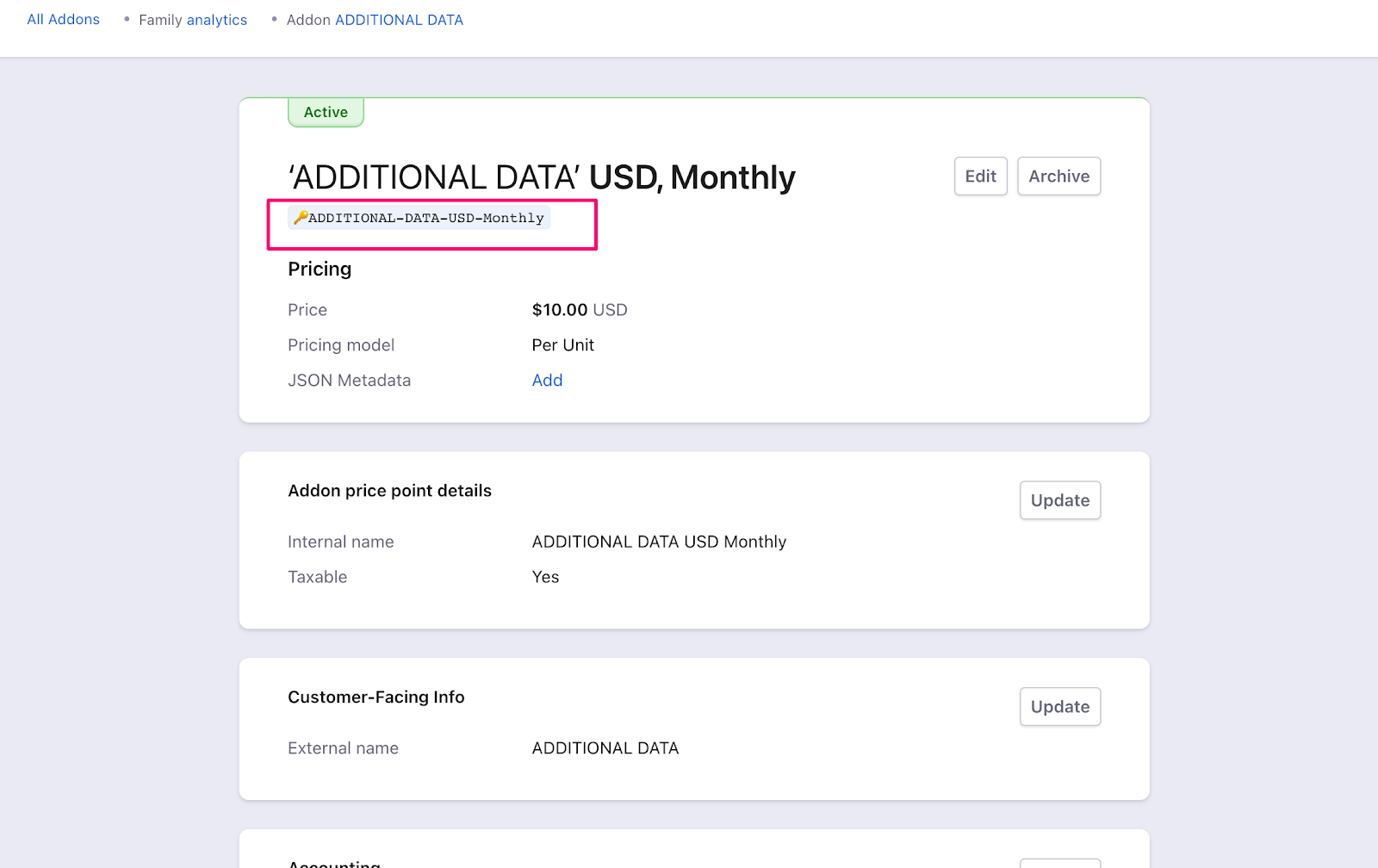
usage[item_price_id]: The id of the item price to which this usage belongs. The item price must be a part of the subscription or should have been part of it historically.

For example, if you are using the below addon's Price point as the product to charge usages, you need to pass the ID highlighted below to the usage[item_price_id] parameter, as the value:
image

usage[usage_date]: You can pass the date in the DD/MM/YYYY format or MM/DD/YYYY format. Once you upload the sheet to perform the bulk operation, you will be able to set the format for the date parameter.

usage[quantity]: Usage quantity cannot be zero. The minimum value has to be 1. This does not have anything to do with how invoices are closed. The site wide setting you have set up for metered billing (settings> configure Chargebee> Metered Billing), is what will determine how invoices get closed.

All details regarding the parameters to be filled in, are listed here.

Was this article helpful?