

For Founders & CEOs

AI Billing Software Built for Founders Who Ship Fast

You could build your own billing system. But winning this market comes down to how fast you ship, and every engineering hour spent on billing is an hour your product didn't get.

You're closing enterprise deals before you've hired a finance team, running usage pricing that nothing you've built or bought so far was designed to handle. Chargebee provides the modular revenue infrastructure you need so your engineers stay on the product.

Trusted by 6,500+ subscription businesses

Qualifying startups run on Chargebee Billing free until $1 million in cumulative revenue.See if you qualify

Where Are You Right Now?

Still Self-Serve, Adding a Sales Motion

Your first enterprise deal is being quoted in a doc.

Multi-year contracts, usage commitments, and negotiated overrides go out without a spreadsheet or a legal back-and-forth.

Paired with Billing once that contract needs a matching usage plan.

Solution: CPQ

Managing a Credit Ledger In-House

Keeping a usage ledger reliable takes real engineering time that could go into the product.

Token, credit, and subscription pricing run together in one catalog without custom code.

Solution: Billing

Watching Cancellations Climb

A customer burns through their credits, gets hit with an overage charge they didn't expect, and cancels before anyone on your team sees it happen.

A save offer runs at the cancel moment, before the account is gone.

Paired with Payments recovering failed charges on the same accounts so a lapsed card doesn't turn into a lost customer.

Solution: Growth

Preparing for Your First Audit

Revenue recognition still lives in a spreadsheet as a funding round or an audit approaches.

Contract modifications, ramps, and usage revenue recognize automatically under ASC 606. This is the part general-purpose RevRec tools built for flat subscriptions weren't designed for: recognizing revenue from a token or credit balance that draws down unevenly.

Solution: RevRec

You're Solving Enterprise Problems With The Wrong Tools

Your product moved faster than your revenue stack did. A year ago you had one price and a handful of self-serve customers on a card. Now sales is closing multi-year contracts with usage commitments, your best customers are on token or credit pricing, and finance is either a fractional CFO or still you, on a Saturday, in a spreadsheet.

There was never a system built for this in the first place. What's running today is either nothing formal, or something an engineer put together fast to get the first version shipped, and neither one expected a multi-year contract with usage commitments attached to it.

This market moves on speed. The company that ships product faster wins it, and every hour an engineer spends maintaining a tax rule or a payment retry script is time that could have gone into the product itself.

Add What You Need, When the Business Needs It

Chargebee grows in pieces. Start with checkout and subscription billing on day one. Add CPQ when your first enterprise deal outgrows a spreadsheet. Add revenue recognition ahead of your first audit. None of it requires moving off what you started with, and none of it requires a project team you don't have.

Billing

Billing — usage and seats, one catalog.

Token, credit, and subscription pricing run in the same catalog without custom code. A customer on a flat plan and a customer paying per API call show up in the same catalog. Prepaid credit balances run through Chargebee's Prepaid Credit Ledger, so drawdown and top-ups reconcile without a spreadsheet.

Payments

Payments — 40+ gateways, no lock-in.

Route by method, currency, or plan without code, and add or swap gateways without rebuilding the billing stack. Retry logic adjusts by card and issuer on every attempt.

CPQ

CPQ — quote custom deals fast.

Multi-year contracts, usage commitments, and negotiated overrides go out without a spreadsheet or a legal back-and-forth. What sales quotes becomes what finance bills, without a manual handoff in between.

Growth

Growth — catch churn at cancellation.

A save offer runs at the cancel moment, before the account is gone. For teams already on Stripe for payments, this runs without a billing migration first.

RevRec

RevRec — audit-ready revenue schedules.

Contract modifications, ramps, and token or credit balances that draw down unevenly all recognize automatically under ASC 606.

Try the API and MCP Server

Try Chargebee's API Explorer

The API Explorer lets you test Chargebee's API in real time, right in the browser, calling live endpoints for subscriptions, invoices, and customers without writing any code first.

Explore Chargebee's MCP Server

The Chargebee MCP server connects your billing data to AI clients like Claude and Cursor, so you can ask questions about subscriptions, invoices, or usage in plain language and get answers pulled from live data.

Sahil M Bansal

Scaling from open source to enterprise on one billing system

"We needed a billing and invoicing automation tool that could keep up with our double-digit month-over-month growth." This revenue infrastructure allowed CodeRabbit to successfully expand beyond pure product-led growth into enterprise sales without sacrificing its efficient self-service model.

Sahil M Bansal
Senior Product Manager, CodeRabbit
Read story →

Frequently Asked Questions

AI billing software runs pricing, invoicing, and revenue recognition for products priced by usage, tokens, credits, or seats. Chargebee runs subscription, usage, and hybrid pricing in one catalog, so a flat plan and a metered one can sit side by side.

Stripe handles payments and basic subscriptions well. When a deal adds usage commitments, contract ramps, or revenue recognition under ASC 606, that's when a second system comes in. Chargebee runs quoting, billing, and revenue recognition together, without needing one.

Two: churn prediction, which flags an account about to cancel before it does, and payment retry timing, which adjusts by card and issuer on every attempt. Both run on your own account and subscription data. The Chargebee MCP server is separate — it lets you ask billing questions in plain language from the tools you already run the company in, like a customer's lifetime value or which invoices are still open, with role-based, read-only access so a finance lead and an engineer don't see the same thing. It's one of the specific capabilities independent analysts have pointed to in this category.

Yes. You can start on checkout and subscription billing while you're still self-serve. CPQ, revenue recognition, and usage ledgers come into play once a specific enterprise deal or an audit makes them necessary.

Usage-based billing meters and charges for consumption, like API calls or tokens. AI billing software is the broader category: usage metering plus the subscription, quoting, and revenue recognition layers around it. Chargebee covers both in one system.

Either. Some customers move payments and billing to Chargebee entirely. Others keep Stripe for payment processing and run quoting, usage billing, and revenue recognition on Chargebee, connected through the existing integration.

A small technical team can build the checkout flow and the subscription logic without much trouble. What's harder to see going in is the maintenance: a payment network changes its retry logic, or a tax jurisdiction updates its filing rules, and someone has to track that permanently. Those are real engineering hours, and in a market where speed wins, they're hours the product doesn't get. As Salesforge founder Frank Sondors put it: "Building billing isn't a core competency an AI startup should have. It's the same logic as not building your own CRM. Chargebee meant we never had to hire engineers for billing. We hired them to build Salesforge." Chargebee's cost is the cost of that maintenance, already built and current.

One account running four times its expected usage can erase the margin on several others before a month-end report catches it. Seeing that requires the same record to hold both what a customer pays and what they consume: Chargebee tracks usage and revenue on one subscription, so margin per customer comes from actual consumption data.

Yes, including the harder shift a plain subscription catalog can't handle: moving a plan from seats to tokens, or adding a usage layer on top of an existing subscription. In Chargebee, that's a catalog change.

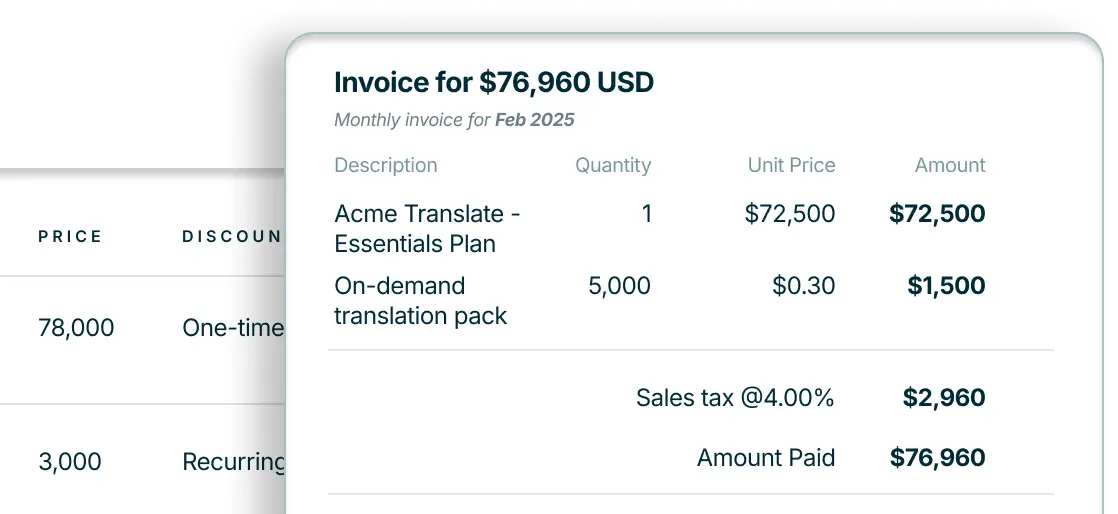
Invoice for a monthly plan, a usage pack, tax, and the amount paid

Start With What You Need Today

This is AI billing software that grows one piece at a time. Add the rest when your business demands it.

Not billing yet?

Check whether you qualify for free billing until $1M in cumulative revenue →