

01
Buy
Self-serve checkout, pricing pages, free trials, and promotional offers, configured in the UI.
Let customers buy, upgrade, and grow on their own.
In a product-led motion, the subscriber does the buying. Every self-serve action adds context about what they may need next. Chargebee connects those signals to checkout, upgrades, retention, and recovery so the experience keeps moving through a self-serve buying experience.
Chargebee runs the buying mechanics from first purchase through upgrade.
Self-serve checkout, pricing pages, free trials, and promotional offers, configured in the UI.
A first-run and onboarding sequence that turns a signup into an activated subscriber.
In-product upgrade prompts and gated tiers a subscriber can act on alone.
A self-service portal for plan changes, payment updates, pause, and cancellation.
The self-serve buying experience
The buying experience carries conversion in a self-serve motion.
Pricing confusion and checkout friction cost conversions at scale, and the buying experience has to carry the sale on its own. Chargebee gives your team configurable pricing pages wired to the product catalog.
A/B test tiers, trial lengths, and promotional offers through the UI. Support 40+ payment gateways in one checkout, with local currencies from day one and guest checkout for speed. Sequence a new subscriber's first year: cooling-off, trial, promotional rate, then renewal.
Proof: A Cloud Guru moved from a flat-fee model to subscriptions and went to market in under a month — customers who never spoke to a salesperson could go online, buy, and get started.
See checkout conversionIn a product-led motion the upgrade happens inside the product. Chargebee's entitlement engine separates what subscribers pay from what they access. Usage and entitlement thresholds can reveal when an upgrade path becomes relevant, so you can surface it at a meaningful limit instead of on a generic schedule.
Surface upgrade offers in-app, at checkout, or during renewal. Move subscribers to annual plans, premium tiers, bundles, or pay-as-you-go add-ons, all self-served. A/B test upgrade prompts against control groups and keep the version that lifts revenue per subscriber.
In Chargebee's 2026 Global Consumer Insights Report, 67% of consumers would switch to pay-as-you-go or hybrid pricing if given the option.
A Cloud Guru's customers self-serve upgrades from monthly to annual plans without a support ticket.
See the full revenue-per-subscriber playbook: Maximize Revenue Per Customer.
Explore entitlementsThe mark of a product-led motion is that subscribers manage themselves. A self-service portal lets subscribers upgrade, downgrade, pause, update payment methods, and cancel without contacting support — lowering support load and making the product feel mature.
Churn Propensity Scores flag risk before cancel intent is explicit. At the cancel moment, the portal can present a pause, skip, downgrade, or targeted offer without a phone call. Win-back gives lapsed subscribers a path back based on why they left.
In Chargebee's 2026 Global Consumer Insights Report, 58% of consumers have paused instead of canceling when given the option.
Study.com lets learners self-serve across five products, with plan changes and payment options handled in the portal rather than by support.
Explore the portalManual payment follow-up does not scale across a large self-serve base. Most involuntary churn is recoverable when recovery runs automatically. Revive adapts retry timing to each failed payment instead of sending every failure through the same schedule.
Failed payments become recovery opportunities instead of support tickets. Gateway routing keeps renewals moving, while payment analytics show where revenue is leaking and why.
Proof: Cafeyn reduced involuntary churn by 90% on Chargebee across its 2M+ digital-press subscribers.
See payment recoveryA self-serve motion reaches subscribers anywhere, so checkout has to localize. Accept 100+ currencies and localize checkout and portals by market.
Automate tax across jurisdictions, from Australian GST to US Sales Tax to EU VAT, so market entry stays a configuration change.
Automate subscription tax“Even if a customer didn't talk to a salesperson, they could go online, buy a subscription, and get started.”
Read story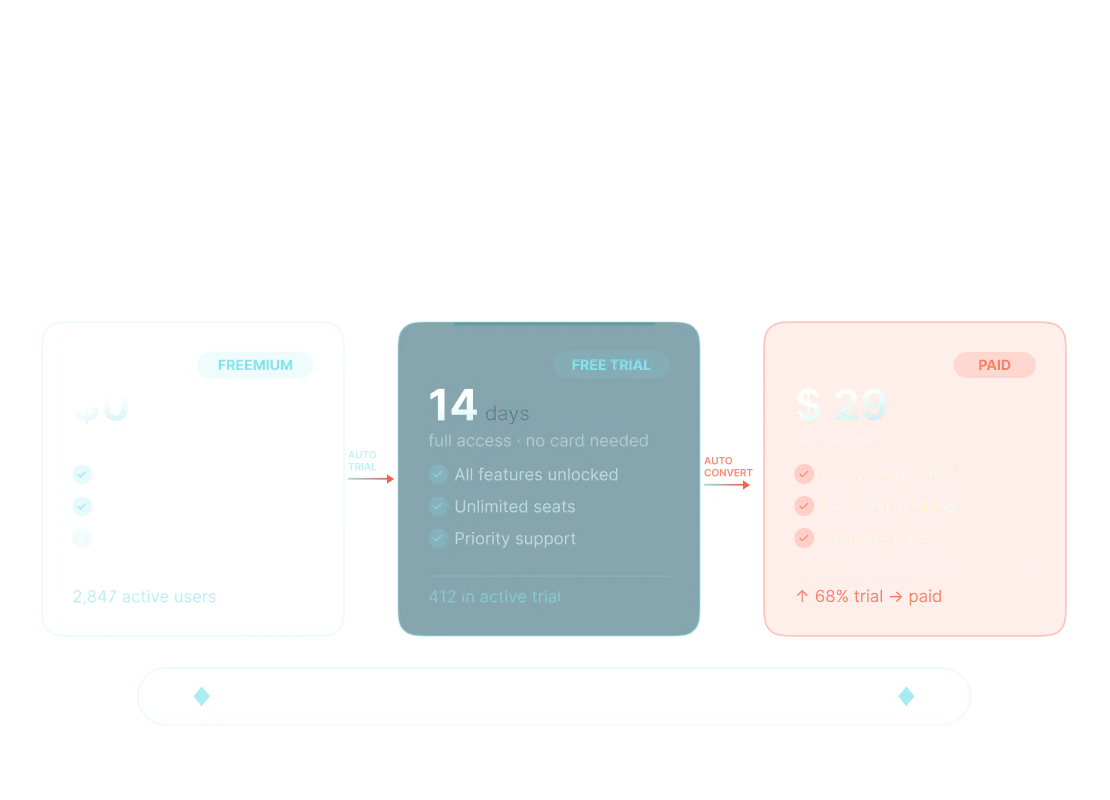
Everything needed to run a product-led motion at volume.
Subscribers buy, upgrade, and manage their accounts on their own.
Tiered pricing, flat-fee plans, and bundles you configure and launch through the UI.
Free-to-paid conversion, entitlement gating, in-product upgrades, and multi-product selling.
High-volume subscriber billing, cancellation management, and win-back flows.
Alternative payment methods, gateway orchestration, dunning, and payment recovery.
Hosted pricing and checkout, self-service portal, and lifecycle offers.
A product-led motion is one where the subscriber discovers, buys, activates, and upgrades on their own, with no sales touch. The product and the buying experience carry the sale rather than a salesperson.
Yes. Chargebee can use entitlement and usage thresholds to trigger an in-product upgrade path when a subscriber reaches a limit. Plan changes, add-ons, and annual switches are all self-served.
No. Engineering handles the initial integration, then product and growth teams configure plans, prices, offers, and entitlement rules in the UI. Pricing and packaging changes ship through configuration.
The self-service portal presents pause, skip, downgrade, or a targeted offer instead of a single confirm step. Win-back campaigns then reach subscribers who did leave, with an offer tied to why.
Revive adapts retries to each failed payment, while gateway routing keeps renewals flowing and card-expiry outreach can refresh details before the next charge fails. Recovery runs automatically without manual follow-up.
Yes. The motion is defined by how the subscriber buys, not by segment. High-volume consumer subscriptions and self-serve B2B products run the same buying mechanics on Chargebee.
Yes. Free-to-paid conversion runs on entitlement gating, so a freemium tier or a time-boxed trial both convert through the same catalog and checkout.
Start free, or see the self-serve buying experience run live in a demo.
G2 Leader, Summer 2026 · 6,500+ customers · SOC 2 Type II