


Billing Software for Pricing, Planning, and Financing AI

AI creates three separate problems for finance: pricing it, planning around it, and financing it.

Chargebee runs one record underneath all three. The price you set, the forecast you build from it, and the number you defend to the board all trace back to it. Every automated step carries a preparer, a reviewer, and a locked period, so what reaches your FP&A deck, a diligence room, or an auditor's sample is the same number your team can walk through line by line with confidence.

Trusted by 6,500+ businesses to run billing, quoting, and revenue recognition on one record

Three Problems, One Record

Pricing it.

Token, credit, and usage-based models multiply the number of exceptions a catalog has to get right the first time. A credit type, a conversion event, and a modification window are each their own accounting question the moment nothing is tracking them.
Planning around it.

A company models a shift from per-seat to token pricing and projects a revenue lift, built from CRM contract values and a product-team usage estimate. Actual revenue comes in well below the old subscription baseline, because a share of customers were over-contracted on seats and under-consuming on tokens, and that data lived in billing the whole time, invisible to a model built from CRM estimates. Chargebee holds contracted ARR and usage on the same record, so the forecast starts from what customers are currently paying and consuming.

Financing it.

Every AI feature that reaches the roadmap becomes a line in next year's budget, and the CFO has to defend the return on it with numbers that trace back to the same record you recognize revenue against. That means the ROI case for an AI feature holds up under the same audit as everything else on the books.

Automation With an Owner on Every Action

The question was never whether finance should automate or use AI across the close, the forecast or collections. It's whether every automated action still has a preparer, a reviewer, and a record someone can point to when a number will inevitably get questioned.

Chargebee builds AI and ML into its product only where that record comes with it, for problems that are genuinely hard to solve well without automation.

Four Finance Roles, Four Different Numbers to Defend

CFO

Recognized revenue and MRR have to reconcile before Thursday's board meeting.

Billing and RevRec share one commercial record, so the two numbers reconcile without a manual step.

Controller / VP Accounting

A mid-term upsell needs a documented, repeatable method behind the classification.

Every modification routes through the same gate sequence, landing with a preparer, a reviewer, and a locked period.

FP&A

The forecast needs the ARR that's currently billing, after every amendment made since close.

Contract-level ARR exports reflect live commercial state.

Billing / Finance Ops

A pricing change needs to ship this week, without an engineering sprint behind it.

Pricing changes are catalog changes, and Receivables reads the same billing record directly, with no sync lag.

AI Pricing Creates More Exceptions Than a Basic System Was Built to Catch

Whether AI is your whole product or one feature added to a subscription you've run for years, pricing it tends to introduce modification, conversion, and threshold events a system built for flat billing never had to model. Each one becomes a specific accounting question the moment nothing is tracking it.

Prepaid credits with different rules get treated as one balance.

An expiring credit recognizes on expiry. A rolling credit defers until it's used. A refundable credit carries a liability. A system that records all three as a single deferred balance gets the treatment wrong for two of them, and the accounting team has to reconstruct which credit is which from the original contract, at every close.

A free tier with no discrete conversion event has no defensible start date.

A customer uses the product for eight months before paying. Recognition needs a performance-obligation start date, and an invoice date isn't the moment they converted.

Two modification events in one billing period create two of everything.

A customer adds seats mid-month and removes some nine days later. A system built for one change per cycle generates two invoices and two deferred revenue entries for what was really one net change, adding a manual reconciliation line to the close checklist.

A volume threshold discount applies retroactively, and nothing was watching for it.

The contract says a discount kicks in retroactively once usage crosses a threshold. If no system is tracking cumulative usage against that threshold, finance hears about it from the customer, and six closed invoices have to reopen.

Chargebee's rules engine tracks the credit type, the conversion event, the modification window, and the threshold as fields on the record, so each one resolves automatically, before it becomes a close-time surprise.

Every Recognition Obligation Traces to a Record Somewhere

Chargebee's finance stack runs on one record, so a recognition schedule, an ARR number, and a collections case all trace back to the same source.

Billing

Billing — one catalog, every model.

Usage, seats, credits, and subscription pricing run in the same catalog. Contract-level ARR reflects live commercial state as it stands today, after every amendment.

CPQ

CPQ — what sales quotes becomes what finance bills.

Multi-year contracts, ramps, and negotiated overrides go out from the same catalog Billing runs on, so a signed quote becomes the billing record itself at close.

RevRec

RevRec — the revenue recognition with subledger built to survive an audit.

Every modification routes through the same gate sequence, lands with a preparer and a reviewer, and posts one summarized entry per period to the general ledger.

Receivables

Receivables — collections that read the record directly.

Risk scoring, reminder sequences, and dispute resolution run against the same billing data RevRec recognizes from. A collector approves before anything sends, until a segment earns enough trust to run on its own.

Ask Billing Questions in Plain Language. Get an Answer With a Preparer's Name On It.

The Chargebee MCP server connects your billing data to Claude, Cursor, ChatGPT, and Codex, so finance can ask a real question and get a computed answer without filing a request with the billing team. The recipe library has prompts built specifically for the CFO and Controller seat:

Annual vs. monthly revenue stability.

Splits MRR into revenue under an active contract term versus revenue with no term commitment, so exposure gets measured by what the contract says rather than how often it invoices.

Involuntary vs. voluntary churn separation.

Separates cancellations triggered by a failed payment from customers who chose to leave, so the win-back list and the retention conversation don't get mixed together.

Add-on revenue concentration risk.

Ranks add-on revenue by customer and flags how much of it sits in the top one or five accounts, ahead of a board conversation about revenue stability.

Coupon and discount dependency health check.

Pulls every discount on an account's invoices and calculates what revenue would look like if those coupons expired.

Browse the full MCP recipe library →

A general model will give a confident explanation with nothing behind it. Chargebee MCP computes its answer from the same billing data your account runs on, and every query lands under the asking person's name and role in the audit trail, the same way it would if they'd looked it up in the dashboard themselves.

“We can finally look at our data, believe the numbers, and act on them. That shift has completely changed how we make decisions.”

Iain Bridges
CFO, BizzyCar
Read the BizzyCar story →

“We use Chargebee to maintain centralized billing across multiple entities. This has greatly improved scalability and efficiency, saving our billing team valuable time.”

Martin Konop
CFO, Phrase
Read the Phrase story →

“We manually managed revenue recognition on spreadsheets, which was very time-consuming. If we found anomalies during month-end closes, it was tedious to trace it back to the original transaction and verify.”

Mark Gagen
Director of Finance, MacStadium
Read the MacStadium story →

Frequently Asked Questions

AI billing software runs the billing, quoting, and revenue recognition record that AI tools in finance depend on for accurate input. Chargebee runs subscription, usage, and hybrid pricing on one record and recognizes revenue from that same data under ASC 606/IFRS 15, so a Controller's AI assistant and the audit trail behind it draw from the same source.

By whether the step has one correct answer or a judgment call behind it. Churn prediction, payment retry timing, and Receivables' risk scoring each work toward a defined, checkable outcome, so those run automatically inside a guardrail. Locking a period, approving a collections action outside policy, and signing off on a schedule are judgment calls, so those wait for a named person, every time.

For research and drafting, yes. A general model will locate the relevant guidance, apply it to your contract, and explain the reasoning faster than reading the standard yourself. It won't build the schedule, post the journal entry, or lock the period, and the conversation itself isn't part of the accounting record an auditor can sample. Chargebee RevRec runs the same determination through its own rules engine, builds the schedule, and posts the entry.

No. RevRec runs natively with Stripe Billing, Chargebee Billing, NetSuite, Sage Intacct, QuickBooks, and Xero, syncing invoice and billing data automatically. A team with no plan to replatform this year can still add Chargebee RevRec on top of its existing stack.

The model needs two numbers from the same source: what each customer is currently contracted for, and what they're currently consuming. When ARR comes from the CRM and usage comes from a product-team estimate, the two rarely reconcile and the forecast misses in the first quarter after the switch. Chargebee holds contracted ARR and usage on the same record, so the transition model runs on what customers currently pay and consume.

The data room runs on one core breakdown: ARR by contract, customer, product, and cohort. An acquirer or investor rebuilds that breakdown independently from your billing history and compares it to what you presented, and any gap between what the CRM shows and what was billed gets found. A structured record produces that breakdown in days. Without one, teams can spend weeks reconstructing it from spreadsheets and invoice PDFs first.

A small team can build schedule logic for a stable set of contract types without much trouble. What's harder to see going in is the maintenance: a guidance amendment or an industry-specific interpretation arrives on its own schedule, and someone has to work out how it applies across every revenue stream and document the rework for audit. Teams absorb that cost repeatedly before anyone notices the work never stopped. Chargebee's cost is the cost of that maintenance, already built and current.

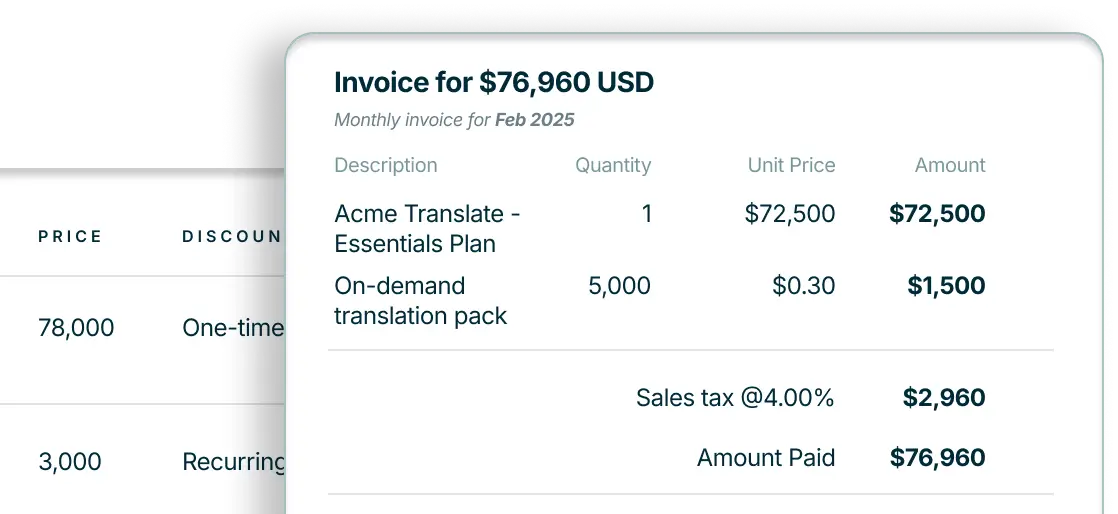
Invoice for a monthly plan, a usage pack, tax, and the amount paid

Close Fewer Days. Defend Every Line.

Chargebee runs the billing, quoting, and recognition record your finance team already depends on, with a plain-language interface your team and your AI tools can both use.

Working through an ASC 606/IFRS 15 question specifically?

See how Chargebee RevRec handles it →