



Multi-Entity Billing for
Every Entity You Run
Chargebee's Multi-Business Entity capability keeps each entity legally separate, its own books, tax profile, and revenue schedule, while finance closes on one consolidated record.
Why do businesses run multiple entities?
Running multiple entities is never the goal. Each one is the outcome of a deliberate, legitimate decision: an acquisition, a new brand, a new market, or an investor's terms. What they share is a single billing requirement: each entity has to operate independently while the group still reconciles into one consolidated view. Miss that foundation, and the same four problems show up every time.
Every acquisition arrives with unverified billing risk
You buy the company, but its revenue stays unverified until billing consolidates. Every quarter of delay costs you more at close.
Consolidate after M&A →Every new brand quietly drifts from policy
You configure each brand on its own, and its tax and revenue rules drift from group standard. You can't defend a drift you can't see.
Unify your brands →Every market adds another entity to reconcile
You enter a new market, and it needs its own tax profile, currency, and legal entity. Every market you add multiplies what finance has to reconcile by hand.
Expand into new markets →Every entity is an obligation before opportunity
A new customer, investor, or regulator requires a local entity, and your first question is whether it reports into the close.
Meet the mandate →Stop outgrowing your billing infrastructure
Your billing stack was built to run one entity. Then you added more. Chargebee's Multi-Business Entity is the layer that runs every legal entity you add, without losing the controls, compliance, or reporting any single one of them needs.
Choose Chargebee. Grow your entities. Lose the fragmentation.
See how finance teams run multi-entity billing on Chargebee






Questions to ask
before you pick a billing platform
Your answers decide whether your systems hold up as you grow with entities: compliance at the entity level, scale without duplicated setup, localization that doesn't split the record, and reporting across every entity and the group. This checklist gives you the questions to ask any vendor before you commit.
Get the checklist →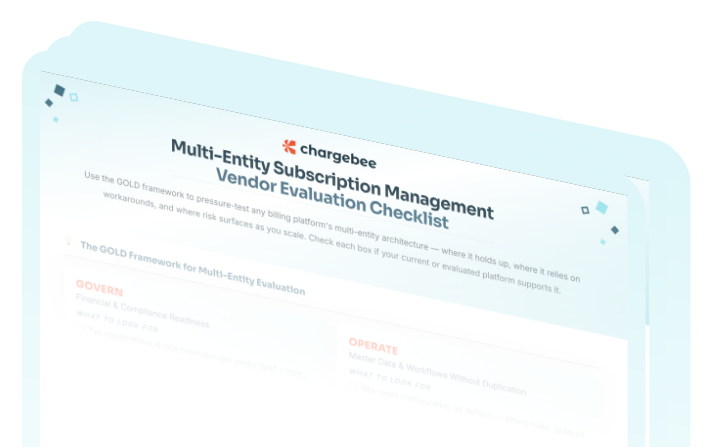
How is your business expanding today?
“Our customers experienced no disruption during the transition because we maintained our legal entity structure.”
Laura Peters
General Accounting Manager


Absorb an acquisition without absorbing its billing stack.
A deal lands a whole business on your desk, and its financials have to stand on their own while the paperwork closes. On one Chargebee site, the acquired entity keeps its own books, tax profile, and revenue schedules from day one, and still rolls into a group view you can drill into at close.
What you get
- One invoice, one legal entity: Separate financials, tax profiles, and revenue recognition per entity, so nothing bleeds across the deal.
- Move customers when you're ready: Customer Transfer reassigns a subscription to the acquiring entity at its next renewal, with limited edits until then, so you plan the switch around renewal dates.
- Schedules that survive the audit: ASC 606 and IFRS 15 tracked per entity and defensible, without an export-to-spreadsheet step.
- Entity-aware ERP and CRM: Each entity flows into NetSuite, Intacct, or Salesforce, mapped to the right subsidiary or account per entity.

After divesting from AGCO to private equity, GSI runs separate US and Canada legal entities on one Chargebee stack, keeping audit-ready revenue recognition per entity while the group reports as one.
“Our customers experienced no disruption during the transition because we maintained our legal entity structure.”
Laura Peters
General Accounting Manager
Launch a brand without launching a billing stack.
Whether you run a house of brands or a branded house, each one needs to bill, look, and report like its own company without a new billing stack each time you launch. Chargebee runs every brand on one site with its own identity, catalogue, and team access, while finance keeps a single consolidated view.
What you get
- Brand-level styling: Logo, color, email, invoice, checkout, and self-serve portal set per entity, or inherited from the site.
- A contained experience per brand: Each brand keeps its customers inside its own checkout and portal, end to end.
- Separate catalogues: Product families stay distinct per brand, site-wide or entity-specific.
- Access mapped to the org: Each team sees only the brand it runs, while finance watches the whole portfolio reconcile.

ICHIGO Inc. launched three new subscription brands (Sakuraco, YumeTwins, and Nomakenolife) on the same Chargebee stack, without rebuilding its subscription infrastructure each time.
“When our revenue tripled, we didn't need to reimagine our processes because Chargebee had done all the hard work.”
David Asikin
Chief Technology Officer


Expand into new markets without expanding your billing stack.
Growth into a new market shouldn't require new billing systems. Every entity you add runs smoothly on one Chargebee site sharing the CRM, ERP, and tax connections you already have, while billing runs in local currencies, with each entity's own tax profile and language. You expand the footprint; finance keeps one consolidated view.
What you get
- One site, not a stack per market: Every entity runs on one Chargebee site that connects once to your existing CRM, ERP, and tax tools, so you add a market without adding a new billing instance or needing new tools.
- Per-entity tax and e-invoicing: Manual, CSV, or automated through Avalara or TaxJar, with e-invoicing via Avalara, and registrations, invoice rules, and time zone set per entity.
- Local currencies and payment methods: Bill in local currencies and accept the rails each market runs on: SEPA and BACS in Europe, or ACH in the US, with Smart Routing sending each payment to the best gateway.

Typeform scaled its online forms platform to 150,000+ businesses across global markets, consolidating billing onto a single Chargebee stack as it grew.
“Chargebee's feature-rich platform has streamlined our processes, cutting our vendor count from ten to five, resulting in potential savings estimated at around $1.2 million annually.”
Joaquim Lechà
Chief Executive Officer


Stand up a local entity without waiting on a new billing stack.
Sometimes the decision isn't yours: a major customer wants to contract in-country, an investor wants a local legal seller, a regulator wants a domestic presence. Chargebee lets you meet the requirement fast (even start selling via Merchant of Record) and it reports into the same close from day one.
What you get
- Sell before you incorporate: Using a Merchant of Record (via Reach for Chargebee), you can enter a new market and start billing without first establishing a local entity, then bring billing in-house as the structure matures.
- Fast to spin up: Your first entity is created with existing data migrated in and add more from settings as the structure grows.
- Governance and isolation by design: Role- and entity-based access keeps each entity's data with the people cleared for it, with audit-ready records per entity.

RightNow Media outgrew its homegrown billing as it expanded overseas, spinning up a separate legal entity per international region on one Chargebee stack.
“Our homegrown system worked great for our domestic customers… but when we started to expand internationally, it quickly became clear that our homegrown system was just not flexible enough.”
Ellen Towery
VP Finance & Operations


Global growth on one billing platform.
“When we make a strategic decision to move into a new region, there is nothing that can delay our expansion.”
Antoine LouisetCo-founder & CTO · European e-signature
“A few days is all it takes for us to enter a new market, not months, with native support for localized prices, taxes, and reports.”
Julien HédouxCTO · multi-currency, multi-language
“When we expanded to Brazil, we needed to offer boleto payments. We set this up entirely through Chargebee.”
Silvia Valero VercheChief of Product Expansion
“We reduced our accounting close time from 10 days to just four days, which we're optimizing further.”
Mark GagenDirector of Finance · multi-entity finance
“With Chargebee, we expanded into five new countries, something that would have been challenging with our previous solution.”
Riaz HatiaEngineering Manager · cloud computing
“Chargebee has been our strong partner in this growth journey, powering our billing, invoicing, and hybrid subscription platform.”
Ajay BulusuCEO · location intelligence
“As a finance leader, I value Chargebee for its comprehensive revenue management platform that provides visibility, control, and accuracy. It helps us solve challenges beyond billing.”
Malika KenzhebaevaCFO & Finance Leader · video platform
“When we make a strategic decision to move into a new region, there is nothing that can delay our expansion.”
Antoine LouisetCo-founder & CTO · European e-signature
“A few days is all it takes for us to enter a new market, not months, with native support for localized prices, taxes, and reports.”
Julien HédouxCTO · multi-currency, multi-language
“When we expanded to Brazil, we needed to offer boleto payments. We set this up entirely through Chargebee.”
Silvia Valero VercheChief of Product Expansion
“We reduced our accounting close time from 10 days to just four days, which we're optimizing further.”
Mark GagenDirector of Finance · multi-entity finance
“With Chargebee, we expanded into five new countries, something that would have been challenging with our previous solution.”
Riaz HatiaEngineering Manager · cloud computing
“Chargebee has been our strong partner in this growth journey, powering our billing, invoicing, and hybrid subscription platform.”
Ajay BulusuCEO · location intelligence
“As a finance leader, I value Chargebee for its comprehensive revenue management platform that provides visibility, control, and accuracy. It helps us solve challenges beyond billing.”
Malika KenzhebaevaCFO & Finance Leader · video platform
Frequently asked questions about multi-entity in Chargebee
What is multi-entity billing?
When do you need multi-entity billing?
How does multi-entity billing work?
- Each entity gets its own invoice sequence, tax registration, and legal address.
- Subscriptions, invoices, and revenue schedules are tagged to the entity that owns them.
- Reporting and integrations stay entity-aware, so nothing needs manual re-tagging to reconcile.
What is the difference between multi-entity billing and running multiple billing instances?
- Core billing rules are defined once and inherited by every entity.
- Local overrides apply only where a market requires them.
- Reporting and integrations stay entity-aware inside one system.
Why does invoice numbering per legal entity matter?
- Invoice numbering per legal entity, with separate sequences.
- Automatic billing from the correct legal entity.
- Entity-specific tax registrations (VAT, GST, sales tax IDs).
- Entity-level legal address and remittance details.
How do taxes work in a multi-entity billing setup?
- Each legal entity maintains its own tax registrations.
- Tax logic maps to the correct legal seller and customer location.
- Entity-specific tax rules and overrides apply where required.
How does multi-entity billing affect ERP and accounting integrations?
- Clean ERP flows (NetSuite, Intacct) with transactions correctly separated by entity.
- One integration that understands your multi-entity structure, instead of one connector per instance.
- Entity-level reconciliation and consolidated roll-ups.
Can I deliver a localized experience per entity without separate systems?
- Entity-specific branding across checkout, invoices, and portals.
- Localized notifications and compliant invoice communications.
- Regional payment methods and gateway routing by currency.
- Entity-level pricing or packaging where you need it.
How does FX work across entities?
Does a Merchant of Record replace multi-entity billing?
Can I migrate from a single-entity Chargebee setup?
Is Multi-Business Entity available on every Chargebee plan?
Consolidate the view. Scale your business entities.
Every entity you add, every market you enter, every brand you carry, and every AI agent you put to work connects to billing intelligence built for your growth from day one.
Billing & Monetization
The recurring billing platform that scales from product-led startup to enterprise-grade monetization.
Meter, Price, and Invoice Any Usage Model
From API calls to token consumption, Chargebee handles every usage-based pricing model natively.
Explore UBB →Chargebee Receivables
Intelligent dunning, smart retries, and entity-aware receivables recovery across every market you operate in.
Explore Receivables →Configure, Price, Quote for Complex Deals
Turn complex enterprise deals into simple wins. Quotes, approvals, and contracts in one motion.
Explore CPQ →