New in Chargebee: Explore Reveal and understand your payment performance end-to-end.Try Now
Docschargebee docs
HomeBillingPaymentsRevRecGrowthReveal
Support

Product Updates


  • Release Notes

Getting Started


  • Overview
  • Chargebee Billing Data Centers
  • Object Relationship Model
  • Understanding Sites
  • Chargebee Tech Glossary
  • Articles and FAQ

Implementing Chargebee


  • Implementation Guide
  • Go-live Checklist
  • Articles and FAQ

AI in Chargebee


  • Chargebee Copilot
  • Chargebee MCP Server (Model Context Protocol)

Developer Resources


  • Developer Resources Overview
  • Articles and FAQ

Product Catalog


  • Product Catalog Overview
  • Coupons
  • Articles and FAQ

Subscriptions


  • Working with Subscriptions
  • Billing
  • Orders
  • Articles and FAQ

Customers


  • Managing Customers
  • Account Hierarchy
  • Email Notifications
  • Branding
  • Configure Multiple Languages
  • Articles and FAQ

Entitlements


  • Entitlements Overview
  • Features Overview
  • Feature Management
  • Managing Product Entitlements
  • Subscription Entitlements
  • Customer Entitlements
  • Grandfathering Entitlements
  • Articles and FAQ

Usage Based Billing


  • Understanding Usages
  • Setting up Usage Based Billing
  • Usage Alerts
  • Metered Billing
  • Articles and FAQ

Chargebee CPQ


  • Chargebee CPQ
  • Chargebee CPQ for Salesforce
  • Chargebee CPQ for HubSpot

Invoices, Credit Notes, and Quotes


  • Invoices
  • Credit Notes
  • Quotes [Legacy]
  • Transactions
  • Articles and FAQ

Taxes


  • Overview
  • Configuring Taxes
  • Country-specific Taxes
  • Articles and FAQ

Hosted Capabilities


  • Overview
  • Hosted Checkout
  • Hosted Self-Serve Portal
  • Hosted Pages Features
  • Additional Hosted Pages
  • Payment Components
  • Pricing Table
  • Managing Payments with Chargebee.js
  • Mobile-Optimized Hosted Pages
  • Articles and FAQ

Site Configuration


  • Users & Roles
  • Custom Fields & Metadata
  • Approvals
  • Mandatory Fields
  • File Attachments & Comments
  • Advanced Filter Options
  • Multicurrency Pricing
  • Multi-decimal Support
  • Configuring Reason Codes
  • Events and Webhooks
  • API Keys
  • Time Zone
  • Time Machine
  • Transfer Configurations
  • Articles and FAQ

Multi Business Entity


  • Multi Business Entity Overview
  • Customer Transfer Overview
  • Articles and FAQ

Mobile Subscriptions


  • Overview
  • Omnichannel Subscriptions
  • Omnichannel One-Time Orders
  • Mobile Subscriptions (Legacy)

Reports and Analytics


  • RevenueStory
  • Home Dashboard
  • Frequently Asked Questions
  • FAQs for Classic Reports Sunset
  • Articles and FAQ

Integrations


  • Sales
  • Customer Support and Success
  • Finance
  • Tax
  • eInvoicing
  • Marketing
  • Stitch
  • Collaboration
  • Contract Management
  • Ecommerce Management
  • Articles and FAQ

Data Privacy & Security


  • Two Factor Authentication
  • SAML Single Sign-On
  • System for Cross-Domain Identity Management (SCIM)
  • EU-GDPR
  • Consent Management
  • Personal Data Management
  • Compliance Certificates
  • HIPAA Guidelines
  • PCI Recommendations and Integration Types
  • Articles and FAQ

Data Operations


  • Bulk Operations
  • Migration
  • Articles and FAQ
  1. Billing
  2. Taxes
  3. Articles and FAQ
  4. Configuring Taxes
  1. Billing
  2. Taxes
  3. Articles and FAQ
  4. Configuring Taxes

How to configure Inclusive or Exclusive taxes in Chargebee?

Problem Statement

You want to know how to configure inclusive or exclusive taxes in chargebee.

Solution

This article covers:

Price Types for taxes

Catalog price type

Region-based price Type

Price type regulations differ from country to country. Some countries, like the US, allow you to set your prices as inclusive or exclusive of tax as you see fit. Others, like New Zealand or Australia, require your invoices to display a price specifically inclusive or exclusive of taxes.

Chargebee offers the flexibility to configure different price types for taxes to help you charge the right type of tax based on the customer's region.

You can configure the pricing type at both the Currency and Country level.

The currency-based price type is used to indicate if the plan's price is inclusive or exclusive of tax. So if you create a plan with price $100 and the currency USD is set to "Inclusive" price type, Chargebee will consider that $100 to be inclusive of tax.

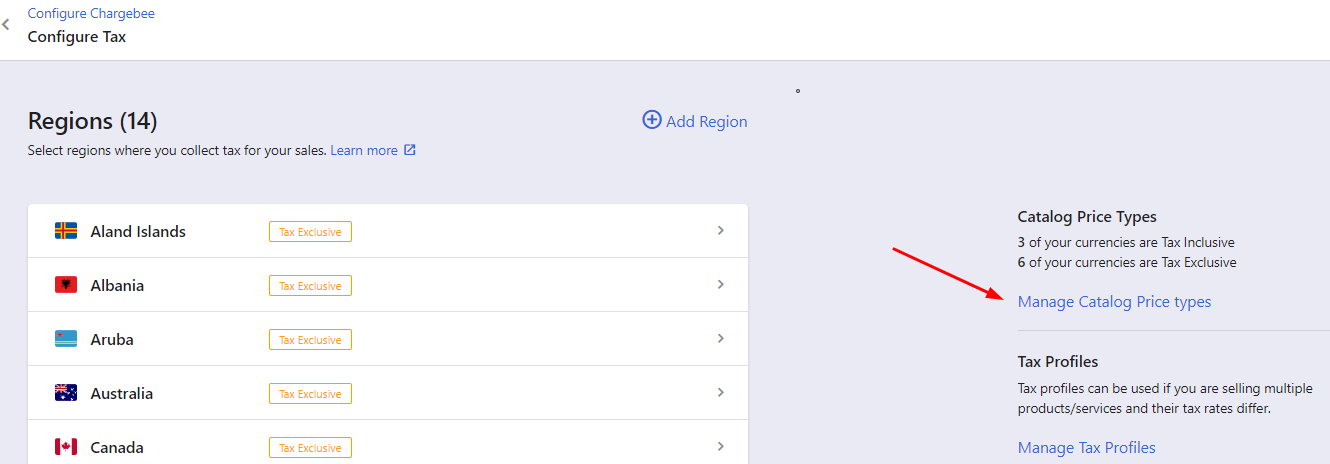
To configure this, navigate to Settings > Configure Chargebee > Taxes > Manage Catalog Price Types under Catalog Price Types on the right. You can configure different price types for each currency that you are selling.
image

The country-based price type determines if the tax break-up needs to be displayed as exclusive or inclusive on the invoice.

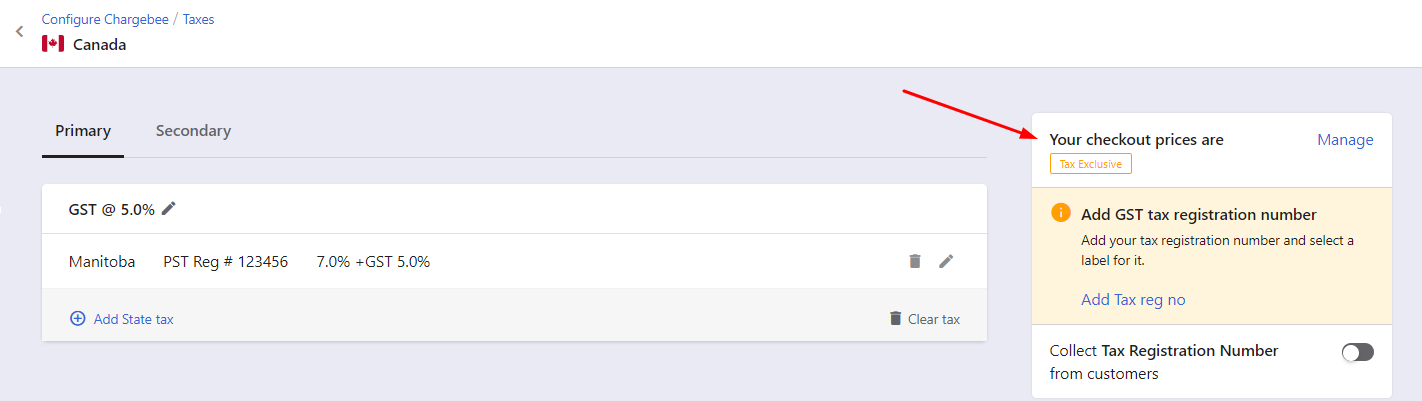
This can be configured on each region-based tax settings. Click on the country on the tax settings page and click on the 'Manage' option on the "Your checkout prices are" link as in the screenshot below.
image

This would be useful if some of the countries you are selling in have regulations that call for a particular price type**.**

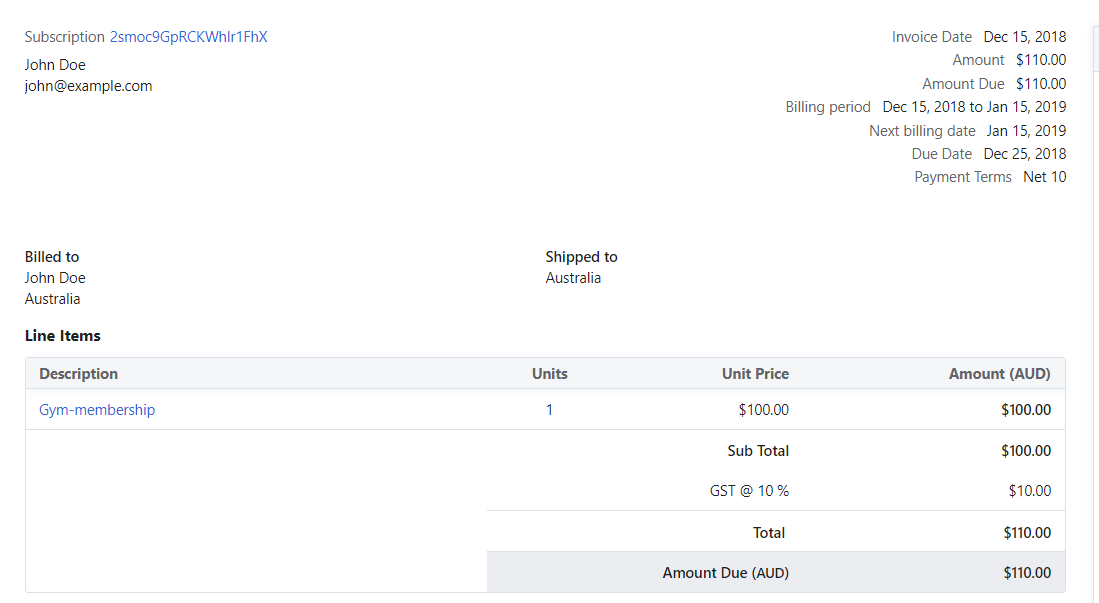
For example, if Australia requires the price type to be exclusive and if the currency is set to inclusive for the AUD currency, Chargebee will carve the tax component from the plan and display the tax amount in an exclusive manner.

So if the plan price is $110 and the tax rate is 10%, the invoice would show the plan price to be $100 and a carved tax of $10 would be displayed. Here is a sample screenshot for your reference.
image

Related Articles

Is 0% a valid tax rate of VAT ?
Uploading customized tax settings (CSV)
Update your EU VAT number in Chargebee to avoid being charged EU VAT in your invoice
What is consistent pricing in Chargebee?
I want to shift from an exclusive tax to inclusive tax, is that possible?
The tax value is different or incorrect
Tax line item not showing on the invoice
Managing tax rate changes
I'm selling products which are subject to different tax rates in the same taxable country
How to apply different tax rates to the different line items of my subscriptions on my invoice via API?

Show more

Was this article helpful?