New in Chargebee: Explore Reveal and understand your payment performance end-to-end.Try Now
Docschargebee docs
HomeBillingCPQPaymentsRevRecGrowthReveal
Support

Product Updates


  • Release Notes

Getting Started


  • Overview
  • Chargebee Billing Data Centers
  • Object Relationship Model
  • Understanding Sites
  • Chargebee Tech Glossary
  • Articles and FAQ

Implementing Chargebee


  • Implementation Guide
  • Go-live Checklist
  • Articles and FAQ

Agentic AI


  • Chargebee Copilot
  • MCP Servers

Developer Resources


  • Developer Resources Overview
  • API Explorer
  • Articles and FAQ

Chargebee Apps


  • Chargebee Apps CLI Developer Guide

Product Catalog


  • Product Catalog Overview
  • Coupons
  • Articles and FAQ

Subscriptions


  • Working with Subscriptions
  • Billing
  • Orders
  • Articles and FAQ

Customers


  • Managing Customers
  • Account Hierarchy
  • Email Notifications
  • Branding
  • Configure Multiple Languages
  • Articles and FAQ

Entitlements


  • Entitlements Overview
  • Features Overview
  • Feature Management
  • Managing Product Entitlements
  • Subscription Entitlements
  • Customer Entitlements
  • Grandfathering Entitlements
  • Articles and FAQ

Usage Based Billing


  • Understanding Usages
  • Setting up Usage Based Billing
  • Usage Alerts
  • Prepaid credits

Invoices and Credit Notes


  • Invoices
  • Credit Notes
  • Quotes [Legacy]
  • Transactions
  • Articles and FAQ

Taxes


  • Overview
  • Configuring Taxes
  • Country-specific Taxes
  • Articles and FAQ

Hosted Capabilities


  • Overview
  • Hosted Checkout
  • Hosted Self-Serve Portal
  • Hosted Pages Features
  • Additional Hosted Pages
  • Payment Components
  • Pricing Table
  • Managing Payments with Chargebee.js
  • Mobile-Optimized Hosted Pages
  • Articles and FAQ

Site Configuration


  • Users & Roles
  • Custom Fields & Metadata
  • Approvals
  • Mandatory Fields
  • File Attachments & Comments
  • Advanced Filter Options
  • Multicurrency Pricing
  • Multi-decimal Support
  • Configuring Reason Codes
  • Events and Webhooks
  • API Keys
  • Time Zone
  • Time Machine
  • Transfer Configurations
  • Articles and FAQ

Multi Business Entity


  • Multi Business Entity Overview
  • Customer Transfer Overview
  • Articles and FAQ

Mobile Subscriptions


  • Overview
  • Omnichannel Subscriptions
  • Omnichannel One-Time Orders
  • Mobile Subscriptions (Legacy)

Reports and Analytics


  • RevenueStory
  • Home Dashboard
  • Frequently Asked Questions
  • FAQs for Classic Reports Sunset
  • Articles and FAQ

Integrations


  • Sales
  • Customer Support and Success
  • Finance
  • Tax
  • eInvoicing
  • Marketing
  • Stitch
  • Collaboration
  • Contract Management
  • Ecommerce Management
  • Articles and FAQ

Data Privacy & Security


  • Two Factor Authentication
  • SAML Single Sign-On
  • System for Cross-Domain Identity Management (SCIM)
  • EU-GDPR
  • Consent Management
  • Personal Data Management
  • Compliance Certificates
  • HIPAA Guidelines
  • PCI Recommendations and Integration Types
  • Articles and FAQ

Data Operations


  • Bulk Operations
  • Migration
  • Articles and FAQ
  1. Billing
  2. Hosted Capabilities
  3. Articles and FAQ
  4. Portal
  1. Billing
  2. Hosted Capabilities
  3. Articles and FAQ
  4. Portal

Setting up Facebook Pixel Tracking if I'm using Chargebee Checkout (V3)

Problem Statement

This article helps you understand setting up facebook pixel tracking if i’m using chargebee checkout (v3).

Solution

Tracking Pixels are 1 x 1-pixel images that lets you track the actions of your visitors on your website and measure the conversion.

To set this up, you need to:

  1. Setup Facebook Pixel Tracking on your website

  2. Enable Facebook Pixel Tracking in Chargebee

Step 1: Setup Facebook Pixel Tracking on your website

  • Log in to your business account on Facebook and navigate to the Pixel tab under Event Manager

  • Click Create a Pixel

  • Fill in information about the pixel and click Create

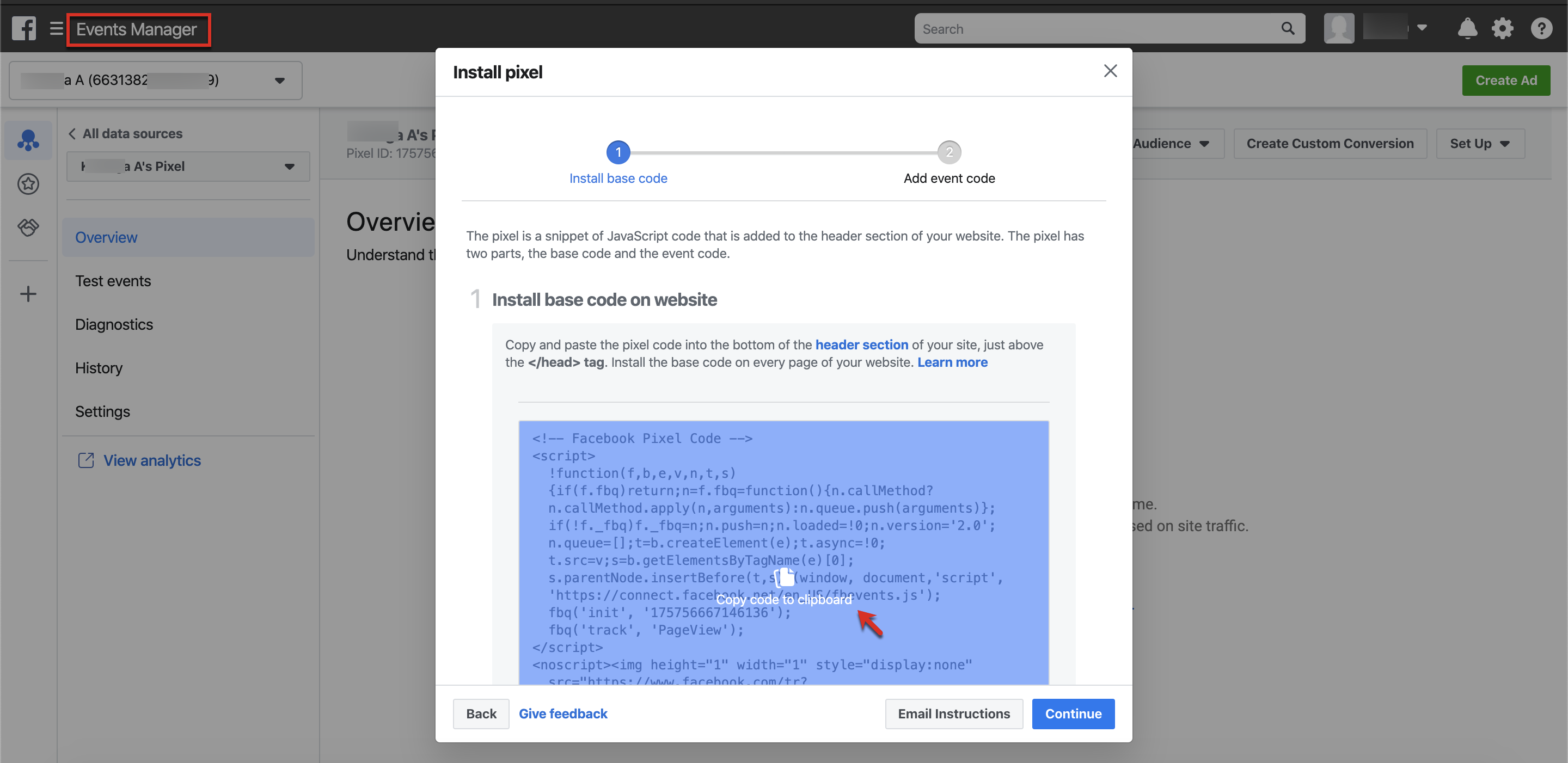
  • In the pop-up window that follows, choose the option Manually Install Code Yourself
    image
  • The subsequent screen will give you the code you need to integrate with your business website. Here's how it's done:

    • Locate the header section in your webpage code (i.e., <head> tags)
    • Copy the pixel code from Facebook and paste it within the header

Step 2: Enable Facebook Pixel Tracking in Chargebee

In Checkout v3, you can enable Facebook Pixel Tracking following one of these approaches:

  1. If you are using Drop-in Checkout
  • Go to Setting > Configure Chargebee > Checkout & Self Serve Portal > Advanced Settings.

  • Add your site domain in the whitelisted domains section

  • In drop-in header script, include the data-cb-fbq-enabled="true" attribute

Sample:

<script 
  src="https://js.chargebee.com/v2/chargebee.js" 
  data-cb-site="your-site" 
  data-cb-fbq-enabled="true">
</script>

  1. If you have integrated via Chargebee Checkout API
  • Go to Setting → Checkout & Self Serve Portal → Advanced Settings

  • Add your site domain in the whitelisted domains section

  • While initializing Chargebee instance, pass the enableFBQTracking parameter with value as true

Sample:

$( document ).ready(function() {

  var chargebeeInstance = Chargebee.init({

    site: "your-site",

    enableFBQTracking: true

  });

});

Related Articles

How can I show plan description on checkout pages?
How to remove/edit the sidebar content on the checkout page?
How can I attach a link to our legal terms and privacy policy pages on the checkout page?
With the V3 hosted pages, is it possible to attach a link to our legal terms and privacy policy pages on the checkout page?
How do I send a user a link to a self-service page to signup for a subscription?
How do I integrate Chargebee's modal checkout with my website on WIX?
How to Generate the hosted page URL? - Legacy Product Catalog
Skip order cart not working
My customers are unable to see specific plans on the portal. Why?
What are the login methods available with Chargebee?

Show more

Was this article helpful?