



Selling to Enterprises Before Your AI Startup Is Operationally Ready
12 MIN READ
|
Updated on May 23, 2025

You didn’t plan to sell to enterprises this early. But now you’re fielding SOC2 requests, negotiating six-figure deals, and firefighting custom feature asks — all while your team is still closing invoices manually and tracking revenue in sheets.
This is what happens when enterprise demand arrives before your startup is operationally ready. It’s exciting. It’s validating. But if you don’t adapt quickly, it can quietly stall product velocity, wreck forecasting, and turn your roadmap into a patchwork of one-off decisions.
And beneath it all, there’s a growing pressure: looking enterprise-ready in the eyes of your prospects — while knowing that behind the scenes, your systems aren’t built for this scale yet.
In short, you’re building the plane while flying it. It’s a cliché, but for AI startups, it’s the most accurate description of what happens when enterprise demand hits fast.
This article is for AI startup founders navigating that messy middle, where GTM success outpaces internal maturity. We break down what breaks, how to stay in control, and how to build just enough structure to scale enterprise sales without overengineering your company too soon.
Unlike traditional SaaS companies that gradually scale from SMB to mid-market to enterprise, many AI startups are being pulled into enterprise sales well before they’re ready. Your product takes off through self-serve users. Then, seemingly overnight, large enterprises start asking for demos, contracts, SLAs, and procurement terms.
The result? A hybrid motion. PLG fuels the entry point. Sales drives expansion. And all of it happens before you’ve put the internal systems in place to support it.
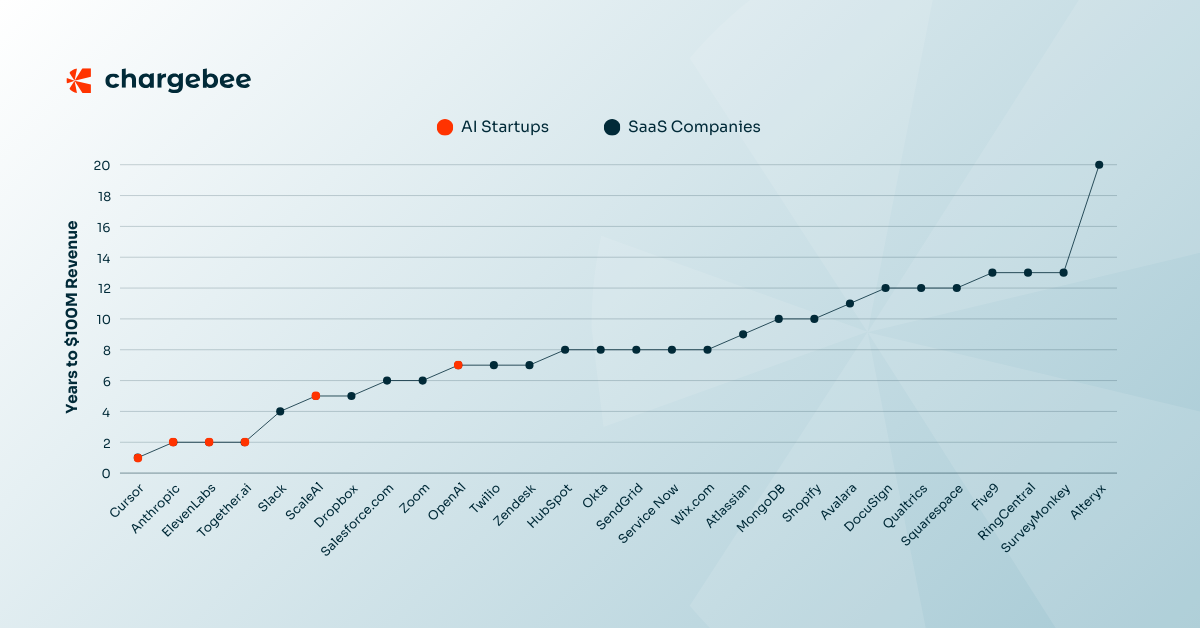
*The chart shows OpenAI at seven years, but we all know it took them far less time — ChatGPT launched in 2022, and by 2024, they were already at $3.7 billion in revenue
At this stage, here are a few founder dilemmas you’re likely to hit — what tends to break, and how to get ahead of it.
You’re closing multi-year contracts with global companies — but your systems and workflows are still built for monthly signups.
When your first few enterprise deals come in, your startup stack begins to fray. Enterprise customers expect consistency, clarity, and follow-through. But internally, every function is scrambling.
What breaks:
This is where the early excitement of enterprise traction becomes dangerous. What felt like a lucky break starts to introduce chaos across teams.
What to do:
Tip: Before adopting tools, map the problems. Many startups default to buying systems too soon. Instead, define your ideal business process first. What data do you need? What do workflows look like when things go right? Start there — then choose tools that support that vision.
Your product may have started through self-serve usage, but now enterprise buyers want custom deals, payment terms, and procurement conversations. PLG is efficient and scalable — but enterprise sales introduce friction, and your internal teams don’t always know how to absorb it.
What breaks:
If you’re still treating enterprise deals like advanced PLG conversions, you’re flying blind. Your motion needs to evolve with your customer.
What to do:
Tip: Don’t lift and shift PLG processes into enterprise sales. That almost always fails. You need to re-architect workflows and roles around the new motion, not copy-paste them into a new system.
You’re still in the process of figuring out how to price your product. Just when you think you’ve nailed down the core value metrics, customers surprise you with new and unexpected ways of using the product — prompting a fresh reassessment of your pricing strategy. And you’re doing all this while market pricing and LLM costs continue to shift around you.
What breaks:
Your pricing model may not be final, but your approach needs to be intentional. Otherwise, you’re just throwing numbers at the wall.
What to do:
Tip: If you’re not tracking the outcome of pricing decisions, it’s hard to know what’s working and what’s not.
You’re booking large deals but you can’t say with confidence how much revenue is being recognized, or whether those deals are profitable. Finance is often underbuilt in AI startups. But as you move into enterprise territory, you need rigor even if you’re lean.
What breaks:
When your revenue starts to grow, what was “good enough for now” becomes a blocker. Enterprise-scale deals need enterprise-grade discipline without the overhead.
What to do:
Tip: Align GTM and Finance early. Without shared data and definitions, you’ll end up with different metrics for the same revenue and major forecasting headaches.
Your enterprise customer wants a feature that no one else has asked for. It’s tempting to say yes. But every one-off request chips away at your product’s scalability.
What breaks:
Every early-stage AI startup hits this crossroads: do we build what the big customer wants now, or do we wait to validate it? The wrong call here can have compounding costs.
What to do:
Tip: Before you commit to any roadmap changes, ask yourself: Is this request a signal from the segment we want to serve or noise from a single logo?
Your champion loves your product — but Procurement hasn’t heard of you. Legal is asking for redlines. IT wants SOC2 documentation. Who’s actually in charge?
What breaks:
This is when sales becomes more complex — multiple stakeholders enter the picture, decisions slow down, and it’s not always clear who holds the final authority.
What to do:
Tip: Enterprise readiness isn’t just a product question — it’s an organizational one. Do you understand the end-to-end impact of each deal? If not, you’re flying blindfolded.
Enterprise selling isn’t just about ACV — it’s about operational maturity. Here’s a checklist to gauge your enterprise sales readiness.
Product
Revenue Operations and Sales
Finance
Segmentation
Systems
Enterprise demand doesn’t wait for perfect systems. Most AI startups land their first large customers long before their internal operations are fully ready.
The challenge isn’t whether you can sell to enterprises — clearly, you already are. The challenge is whether your systems, processes, and data can keep up without slowing down your team or complicating your product.
Every startup builds its plane while flying it. The key is making sure the wings don’t fall off as you gain altitude. Start with what’s essential. Build just enough structure to stay in control. And keep evolving your systems to match the scale of the customers you’re bringing on board.
You don’t need to build everything from scratch to meet enterprise expectations or hire a large back office too soon. Tools like Chargebee can help you put just enough structure in place — whether it’s automating quote-to-cash, tracking revenue across multi-year contracts, or setting up lightweight approval workflows.
The goal isn’t to add overhead. It’s to free up your team to focus on product and growth, while still giving finance, sales, and ops the clarity they need to support bigger deals.
Get a demo →
