
#1 Salesbricks Alternatives

Chargebee vs. Salesbricks

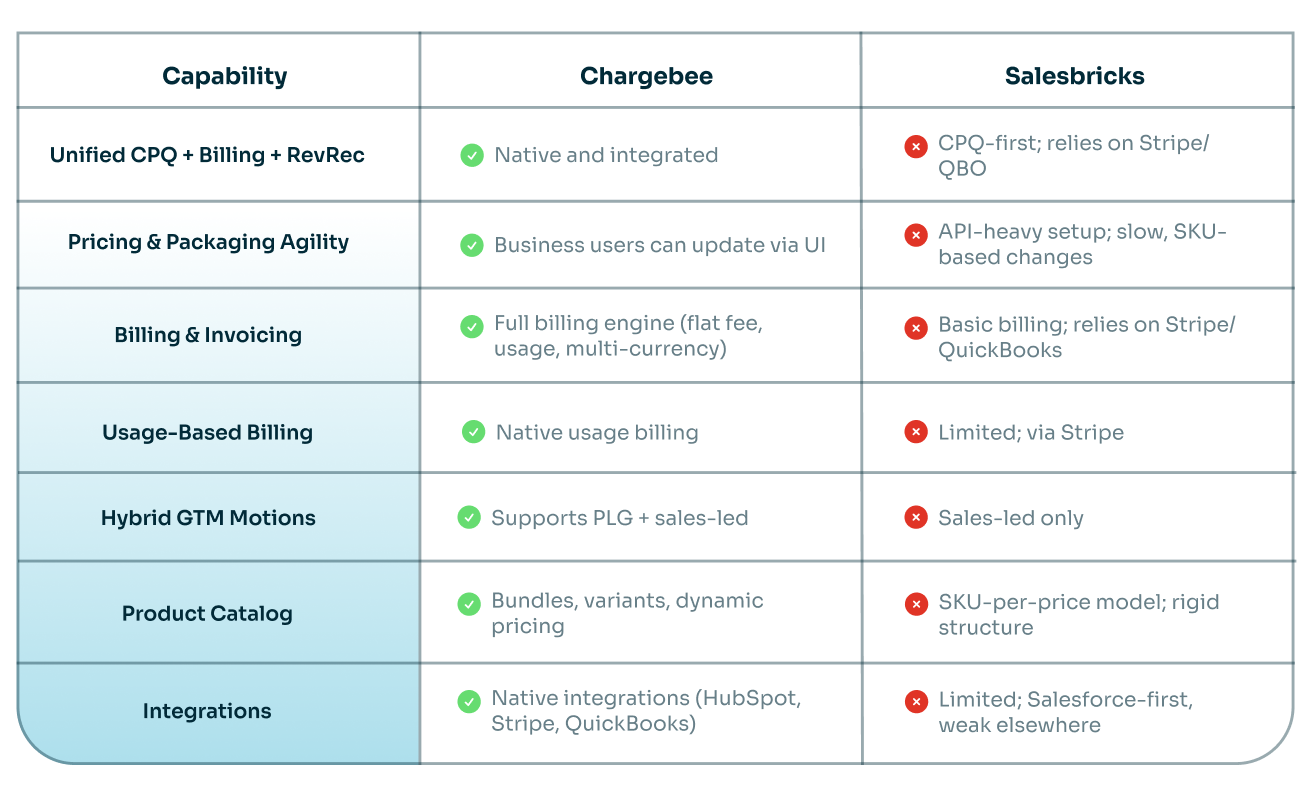
Chargebee lets you quote and manage complex, enterprise deals from day one — keeping pricing, offers, and transactions in perfect sync. Unlike Salesbricks, it scales with your growth, ensuring financial control as your business grows.

  • Launch and iterate on AI pricing without developer effort

  • Offer limited-time trials

  • Bundle AI features into existing plans

  • Automate usage limits and overage logic

  • Track revenue from AI products

  • Add custom pricing or tier upgrades

  • Quote and close enterprise deals confidently

Thanks for contacting Chargebee.
One of our product experts will be reaching out to you to discuss your subscription billing needs

Hate waiting?

Why new age startups move away from Salesbricks

As startups scale AI offerings, Salesbricks’ sales-led setup limits pricing agility, adds manual work, and restricts revenue visibility.

Chargebee Vs Salesbricks
When launching new AI features, startups need to test pricing, segment fit, and adoption fast. Salesbricks, built for sales-led quoting, makes iteration slow and manual. Each change requires setup and coordination across systems, leaving no easy way to pilot new pricing or gather early revenue insights. With only a basic billing setup, founders lose visibility into what customers are willing to pay and which features drive real engagement.
Chargebee Vs Salesbricks
As startups move from pilots to paid AI offerings, they need flexible monetization — usage-based, seat-based, or hybrid. Salesbricks' basic billing setup relies on other tools for invoices and payments, so every new pricing tier or add-on requires manual work. This friction slows down experimentation and turns simple pricing updates into operational projects. For teams refining AI packaging and pricing weekly, those constraints limit how fast they can scale and learn from the market.
Chargebee Vs Salesbricks
To scale sustainably, startups need to understand how AI adoption affects costs and margins, but Salesbricks’ limited visibility makes that difficult. Its basic billing setup relies on other tools for invoice and payment handling, making it hard to track true profitability across customers or products. Without unified revenue insight, teams can’t easily reprice, gate features, or adjust packaging to protect margins as model usage and infrastructure costs evolve.
Chargebee Vs Salesbricks

Keep Your Revenue Moving Fast

Launch offers, trials, and updates instantly so your sales never slow down.

Adapt to Market Changes Quickly

Salesbricks emphasizes an API-first model, which may limit non-technical teams’ ability to make pricing or trial changes independently.

Chargebee’s unified catalog and low-code tools allow changes to go live instantly.

Improve Financial Accuracy and Clarity

Teams using Salesbricks often rely on manual exports and workarounds to align with accounting systems.

Chargebee provides audit-ready reporting, cleaner books, and integrated financial visibility.

Scale Without Operational Friction

Salesbricks’ setup struggles as volume and complexity grow, creating friction in billing and renewals.

Chargebee automates these workflows so you can scale revenue without increasing headcount as your customer base and pricing models expand.

Align Teams Around One Revenue Process

Salesbricks offers limited visibility or controls for finance and support teams.

Chargebee provides shared visibility and access controls, fostering alignment and faster revenue realization

Frequently Asked Questions

Salesbricks offers limited CRM integrations. It connects primarily with Salesforce via API and provides basic HubSpot sync, which requires engineering support for setup. Unlike Chargebee, its CRM access is restricted to sales teams and lacks native automation for cross-functional workflows. Whereas, Chargebee offers deep, native integrations with both Salesforce and HubSpot — enabling quoting, billing, and revenue data to flow seamlessly across sales, finance, and RevOps teams.

In G2’s Fall 2025 reports, Chargebee continued its six-year streak as the #1 leader in Subscription Management and Subscription Billing. G2 user ratings show that small businesses rate Chargebee highly for ease of use, quick setup, and dependable billing performance, and it also received the Fall 2025 Best Results award in the small business segment.

Chargebee’s Starter Plan begins at $0 — it’s free for the first $250,000 in cumulative billing. After that, you pay 0.75% on additional billing. This usage-based model makes it ideal for small businesses and startups looking to minimize upfront costs while scaling gradually.

Salesbricks starts at $500 per month when billed annually and includes a transaction-based fee. Once your billing exceeds $300,000, any amount beyond that is charged at 1.39% per dollar.

Chargebee makes migration simple and low-risk through its flexible migration options and hands-on support. You can run your new Chargebee setup in parallel with your existing billing system, ensuring accuracy before going live. You can choose between self-service or Chargebee-assisted migration, and even opt for a phased rollout to move customers in stages.

From ready-to-use data templates to automated migration tools and unlimited support, Chargebee ensures a smooth, reliable transition — so your business can switch without disrupting billing or customer experience.