Docschargebeedocs

HomeBillingPaymentsRevRecGrowthReveal
Support

Product Updates


  • Release Notes

Getting Started


  • Overview
  • Chargebee Billing Data Centers
  • Object Relationship Model
  • Understanding Sites
  • Chargebee Tech Glossary
  • Articles and FAQ

Implementing Chargebee


  • Implementation Guide
  • Go-live Checklist
  • Articles and FAQ

AI in Chargebee


  • Chargebee Agents
  • Chargebee Copilot
  • Chargebee MCP Server (Model Context Protocol)

Developer Resources


  • Developer Resources Overview
  • Articles and FAQ

Product Catalog


  • Product Catalog Overview
  • Coupons
  • Articles and FAQ

Subscriptions


  • Working with Subscriptions
  • Billing
  • Orders
  • Articles and FAQ

Customers


  • Managing Customers
  • Account Hierarchy
  • Email Notifications
  • Branding
  • Configure Multiple Languages
  • Articles and FAQ

Entitlements


  • Entitlements Overview
  • Features Overview
  • Feature Management
  • Managing Product Entitlements
  • Subscription Entitlements
  • Customer Entitlements
  • Grandfathering Entitlements
  • Articles and FAQ

Usage Based Billing


  • Understanding Usages
  • Setting up Usage Based Billing
  • Usage Alerts
  • Metered Billing
  • Articles and FAQ

Chargebee CPQ


  • Chargebee CPQ
  • Chargebee CPQ for Salesforce
  • Chargebee CPQ for HubSpot

Invoices, Credit Notes, and Quotes


  • Invoices
  • Credit Notes
  • Quotes [Legacy]
  • Transactions
  • Articles and FAQ

Taxes


  • Overview
  • Configuring Taxes
  • Country-specific Taxes
  • Articles and FAQ

Hosted Capabilities


  • Overview
  • Hosted Checkout
  • Hosted Self-Serve Portal
  • Hosted Pages Features
  • Additional Hosted Pages
  • Payment Components
  • Pricing Table
  • Managing Payments with Chargebee.js
  • Mobile-Optimized Hosted Pages
  • Articles and FAQ

Site Configuration


  • Users & Roles
  • Custom Fields & Metadata
  • Approvals
  • Mandatory Fields
  • File Attachments & Comments
  • Advanced Filter Options
  • Multicurrency Pricing
  • Multi-decimal Support
  • Configuring Reason Codes
  • Events and Webhooks
  • API Keys
  • Time Zone
  • Time Machine
  • Transfer Configurations
  • Articles and FAQ

Multi Business Entity


  • Multi Business Entity Overview
  • Customer Transfer Overview
  • Articles and FAQ

Mobile Subscriptions


  • Overview
  • Omnichannel Subscriptions
  • Omnichannel One-Time Orders
  • Mobile Subscriptions (Legacy)

Reports and Analytics


  • RevenueStory
  • Home Dashboard
  • Frequently Asked Questions
  • FAQs for Classic Reports Sunset
  • Articles and FAQ

Integrations


  • Sales
  • Customer Support and Success
  • Finance
  • Tax
  • Marketing
  • Stitch
  • Collaboration
  • Contract Management
  • Ecommerce Management
  • Articles and FAQ

Data Privacy & Security


  • Two Factor Authentication
  • SAML Single Sign-On
  • System for Cross-Domain Identity Management (SCIM)
  • EU-GDPR
  • Consent Management
  • Personal Data Management
  • Compliance Certificates
  • HIPAA Guidelines
  • PCI Recommendations and Integration Types
  • Articles and FAQ

Data Operations


  • Bulk Operations
  • Migration
  • Articles and FAQ
  1. Billing
  2. Subscriptions
  3. Articles and FAQ
  4. Calendar Billing
  1. Billing
  2. Subscriptions
  3. Articles and FAQ
  4. Calendar Billing

Changing the billing date to a different date when calendar billing is enabled

Problem Statement

This article helps you understand changing the billing date to a different date when calendar billing is enabled.

Solution

Summary

Calendar Billing feature lets you set a specific billing date for your customers, regardless of their signup, to suit your business needs. Therefore, to change the billing date, you have to disable the calendar billing feature and re-enable the same after changing the billing date. This may affect the customers who signup in the interim before the change gets processed.

We have migrated to new Self-Serve Calendar Billing configuration from 23 March 2023. Self-Serve Calendar Billing allows you to add multiple Site-level & Plan-level configurations also supports Yearly billing frequency. With this new configuration, you can manage both SaaS and E-Commerce business. Besides, the Advance trigger allows you to set calendar billing for specific events. Reach out to our support to enable this feature on your site.
Refer to this link on how to configure Self-Serve Calendar Billing for SaaS business
Refer to this link on how to configure Self-Serve Calendar Billing for E-Commerce business

For example, when you disable the Calendar Billing from your site to change the renewal date to April 15th and enable it back after you are done with changing the billing date, during this time period of having it disabled, if a customer signs up to your site, for example, on March 18, his billing date will be aligned to the 18th of every month.

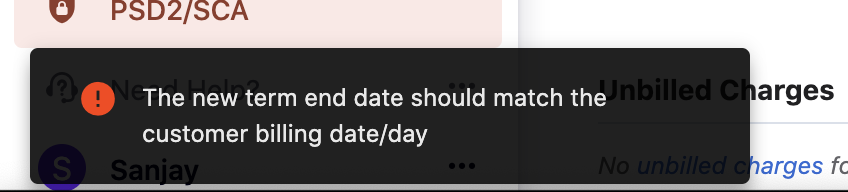
When Calendar billing is enabled, the "Change end term" option restricts you from changing the term end date. As a result of this, you may experience an error as stated below,
image

To avoid this raise a request with support to disable calendar billing from backend and perform a bulk operation as stated below to change the billing date.

Bulk operation for Changing the billing date

For example, Assume that you want to change the billing date to Apr 18th rather than charging your customers on Apr 1st. To do this,

  1. Go to Subscriptions and check for the subscriptions that need a billing date change.

  2. Now Go to,

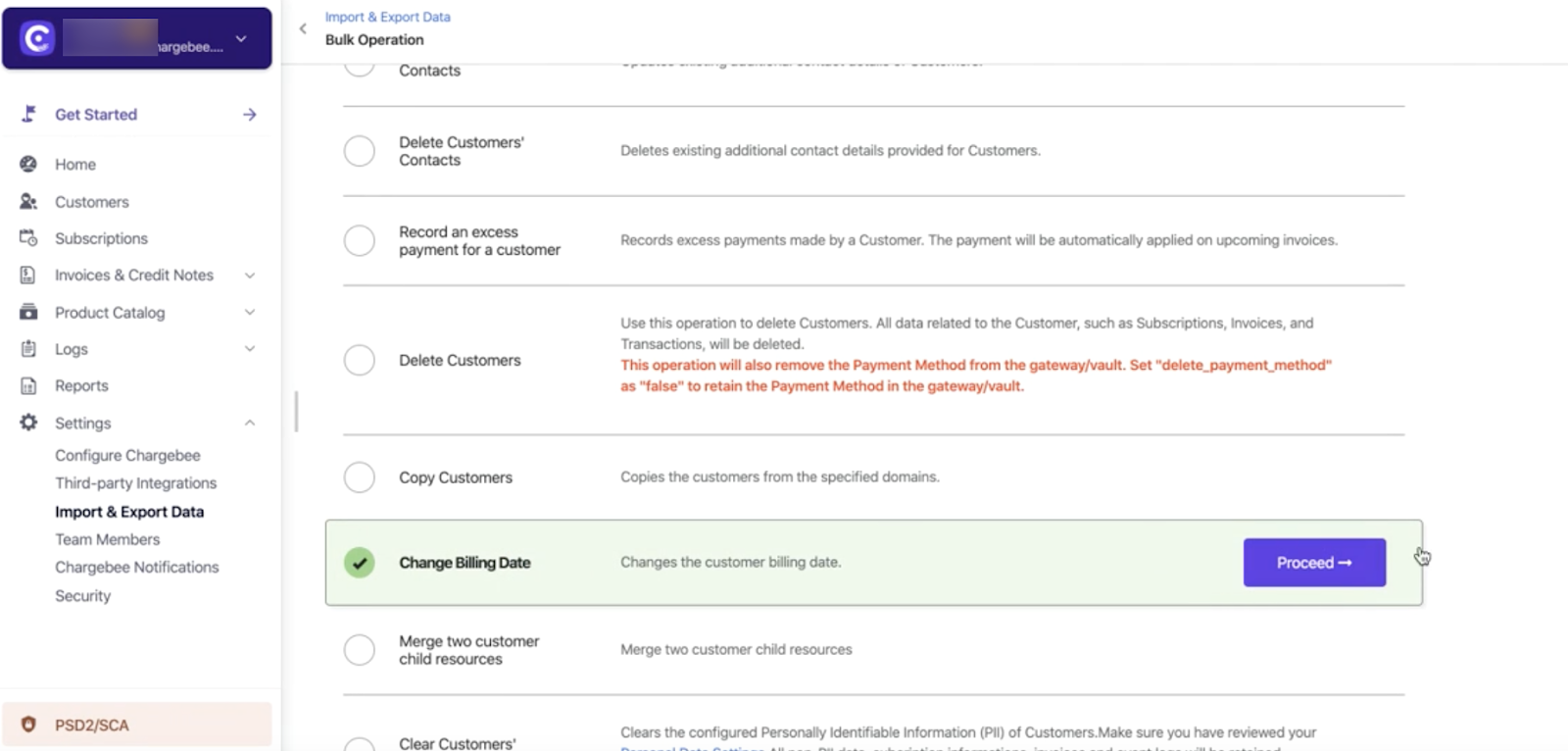
    Settings Import and Export data Choose a Bulk Operation Select Subscriptions Change Billing date Click Proceed
    image
  3. Download the sample .CSV file provided and fill in the fields such as customer[id], customer[billing_date], customer[billing_date_mode], etc.

  4. Download the .CSV file created and upload the same using the upload option as given in the above image.

  5. Edit/Check the field details under Map Columns and click Next

  6. Select Allowed Values as manually_set under Map Enumerated values and click Submit.

  7. Select Disable Webhooks and Disable Email Notifications under Change Billing date and click Continue

  8. The operation validates the .CSV file. Click on Update (n) customers

  9. Click View Customers. You will now be redirected to the "Customers" page.

  10. Go to Subscriptions and select the subscriptions that need a billing term change and click on Change term end

<Image src="/assets/screenshots/kb/billing/0To2lSXyYmEVG5qDbguezR3yt3w9zCsN8g.png" alt=""/>
  1. Choose a term end date and Click on Apply.

  2. You can now view the changed term end date on the "Subscriptions" page

NOTE:

  • After changing the term end date using the above process (with calendar billing enabled), your customers will be charged on Apr 18th. To reset the billing date back to 1st May perform the above steps once again.

  • If a single customer holds multiple subscriptions then, setting a new billing date will align all those subscriptions to the changed term end date.

Here's a video demonstration of the above function.

Related Articles

Calendar Billing date not applied for a few subscriptions
What would be the monthly billing date of customers whose billing date fall on the 31st of the month?
How does calendar billing work with subscriptions with 'Future Start'?
How does calendar billing work with subscriptions that has a trial period?
We only ship products to our customers during a certain time of the month (or particular day of the month). How can this be setup?

Show more

Was this article helpful?