



AI-Driven Retention Offers: Turn the Cancel Moment Into an Experiment
11 MIN READ
|
Updated on September 22, 2026

Retention now sits at the top of the revenue agenda: 53% of recurring-revenue businesses name customer retention as a top concern. AI-driven retention offers are save offers that read each customer’s health and reason for leaving, then present the specific incentive most likely to keep that customer, instead of showing everyone the same discount. The cancel screen is where this plays out, and a one-size discount either fails to save the customer or gives away margin on a customer who would have stayed.
Most teams ship a single cancel flow, wire it up once, and then sit flying blind until renewal tells them whether it worked. That leaves the highest-stakes moment in the subscriber lifecycle running on guesswork. This guide covers how AI predicts churn before the cancel click, runs the cancel moment as a measured experiment, personalizes offers by reason to leave, and recovers the involuntary churn that quietly drains recurring revenue.
AI-driven retention offers are save offers selected by a model that scores each subscriber’s churn risk and matches the incentive to their specific reason for leaving. A static offer treats every canceling customer the same, so the real reason a subscriber is leaving stays invisible and the same discount lands on people with very different motivations.
At-risk subscribers form several distinct groups. Chargebee’s consumer research identifies five consumer subscription archetypes, with “Flight Risks” the largest segment at 45%. Segmentation like this is why a blanket offer underperforms: an anxious spend-optimizer and a satisfied loyalist need different treatment at the same cancel screen.
Static discounts apply the same percentage to everyone and optimize for nothing. AI-driven offers use billing-backed audience data to decide who sees an offer, which offer they see, and whether an offer should appear at all. The result is a decision per subscriber rather than one blanket rule that overpays some customers and underserves others.
Retention offers act at the point of cancel intent, after acquisition and expansion, when a subscriber signals a readiness to leave. They reduce voluntary churn and protect the customer lifetime value already earned. Each save compounds, because a retained subscriber keeps generating revenue that acquisition spend does not have to replace.
By the time a customer clicks cancel, most of the value is already lost, so prediction has to happen earlier. AI reduces churn by moving the intervention upstream: it reads first-party billing signals, scores who is drifting toward the exit, and prompts an action before the cancel screen.
The pipeline runs in three stages. Billing data, including subscription events, payment history, plan attributes, and MRR, feeds a churn model that produces a score, and the score triggers an action: a proactive offer or a cancel-flow experiment. Because the data originates in the billing system rather than a downstream CRM copy, the signal is current instead of synced hours or days late.
Chargebee Growth produces AI Churn Scores using a personalized machine learning model trained only on each customer’s own Chargebee Billing data. The model draws on 48 data attributes across six categories, including customer profiling, subscription history, payment behavior, and price fluctuation, and returns a score from 1 to 99. Each business gets a model trained on its own subscriber patterns rather than a generic pooled benchmark.
Many teams treat the cancel screen as the least-tested surface when it should be the most-tested one. The cancel-moment-as-experiment framework fixes that with a four-step loop: reason for leaving, matched offer, measured save rate, then iterate. Each cancellation feeds the next test, so the flow learns which offer retains which subscriber instead of repeating one guess forever.
The loop captures why the subscriber wants to leave, presents an offer matched to that reason, measures the resulting save rate, then feeds what it learns into the next round. TouchNote ran exactly this kind of targeted testing program and increased its cancellation save rate by 56% in under 12 months with Chargebee Retention, moving save performance from 16% to 25%. The same analysis showed a 40% discount performed almost identically to a 50% one, so the team retained customers while giving away less margin.
The cancel screen is the one moment where intent is explicit and getting it wrong means a lost subscription. A small lift in save rate here returns retained revenue immediately, and every variant tested teaches the model something for the next subscriber. Chargebee Retention delivers this as no-code cancel flows with branching logic that a product or commercial team can configure and take live in one to two weeks, without waiting on dev. A supporting walkthrough of flow mechanics lives in our cancellation flow examples guide.
A blanket discount overpays customers who would have stayed and underserves those leaving for reasons price cannot fix. Personalizing retention offers by reason to leave means segmenting at-risk subscribers first, then matching the intervention to what is driving the cancel.
Chargebee Growth builds segments from live subscription data, payment history, MRR, and AI Churn Scores, so the audience updates the moment billing data changes. A subscriber who just downgraded, or whose card just failed, moves into the right segment without a manual list refresh or a sync from a separate tool.
A customer leaving over cost and a customer leaving over product fit need different responses. A price-sensitive subscriber may respond to a targeted discount or a pause; a subscriber leaving over quality may respond to a plan swap or a feature that a discount would never address; a subscriber who would have stayed needs no discount at all. Honest, easy offer paths also build trust: 82% of consumers say they are more likely to subscribe when they know cancellation is easy.
Standard testing tools report engagement, and an open or a click signals interest rather than a retained subscription. Testing cancel flows and offers with multivariate experiments means running several save strategies against each cancel reason and measuring the outcome that matters, which is retained revenue.
Chargebee Growth supports A/B and multivariate testing across offers, pricing tables, and save experiences, including multiple save strategies within a single cancel-reason path. Jane put this to work and raised its cancellation save rate from 10% to 16% with Chargebee Retention, a before-and-after improvement driven by testing rather than a single fixed flow.
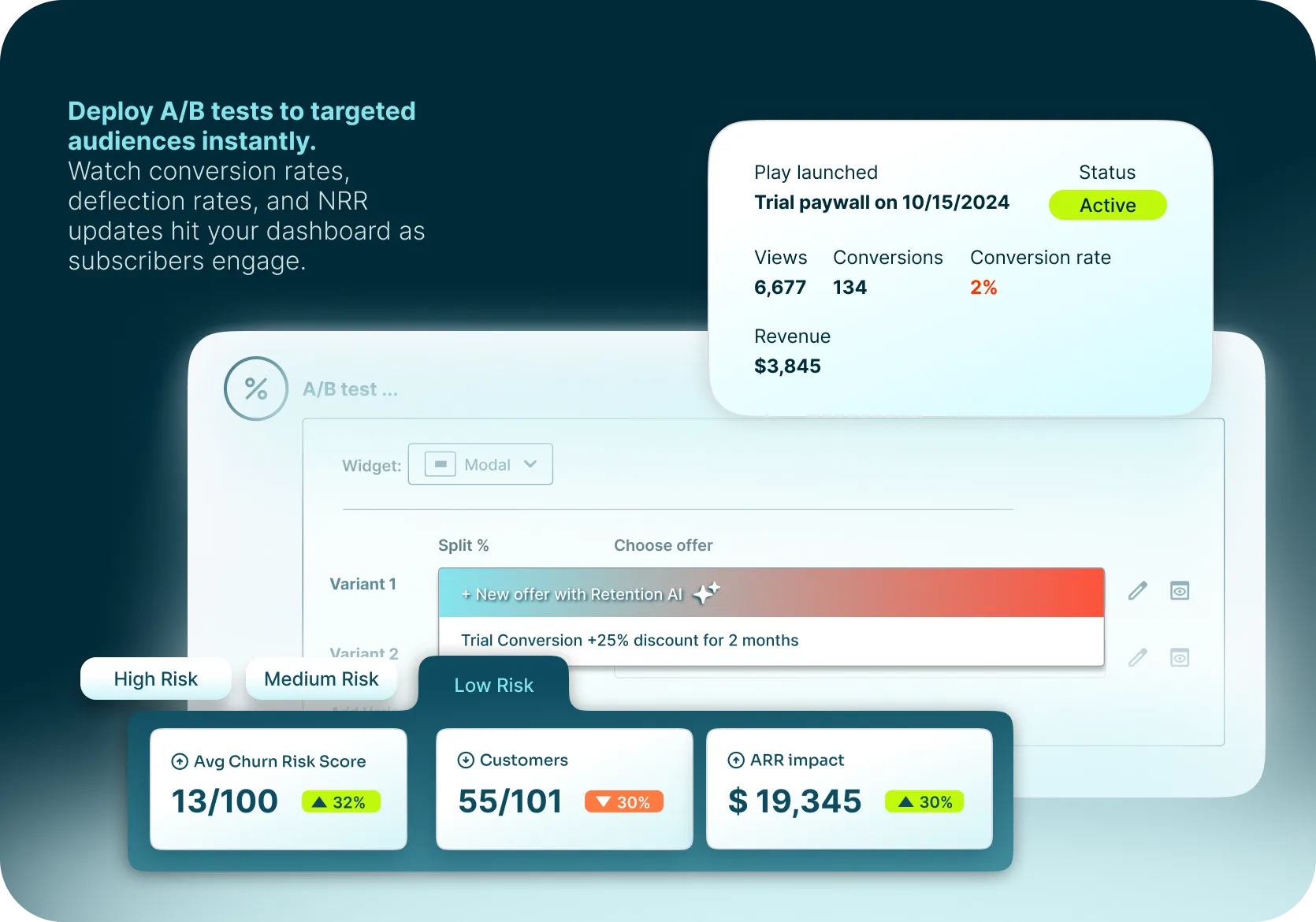
Chargebee Growth experimentation measures whether a save offer or pricing change moved a subscription, because every outcome is applied directly in Chargebee Billing. A save experience that lifts click-through but changes no subscriptions is noise. Measuring retained revenue means finance can trust the number, because it ties back to a billing event, not an engagement signal.
Teams pour energy into voluntary saves while silently losing revenue to failed payments. Involuntary churn is a separate, large leak, and recovering it needs its own mechanism: smart dunning that retries intelligently, refreshes expiring cards, and escalates through a configured sequence.
Involuntary churn happens when a payment attempt fails and a subscription lapses, so the customer intended to stay but the billing system dropped them. This churn is largely recoverable, so every expired card or failed retry left unaddressed is revenue lost from a customer who never chose to leave.
Chargebee Receivables extends Billing’s baseline retries with ML-optimized retry logic, account updater for expired cards, and configurable multi-step dunning sequences. Cafeyn, a digital press subscription service, reduced involuntary churn by 90% in its French market with Chargebee after addressing the technical failures behind its cancellations. Chargebee Growth also recovers involuntary churn from the same Billing data, so voluntary and involuntary saves run from one suite.
A high save rate bought with deep discounts can destroy net revenue, so the metric that counts is retained margin, not raw saves. Measuring retention-offer performance means tracking save rate, retained MRR, and offer cost together, then cutting offers that cost more than they save.
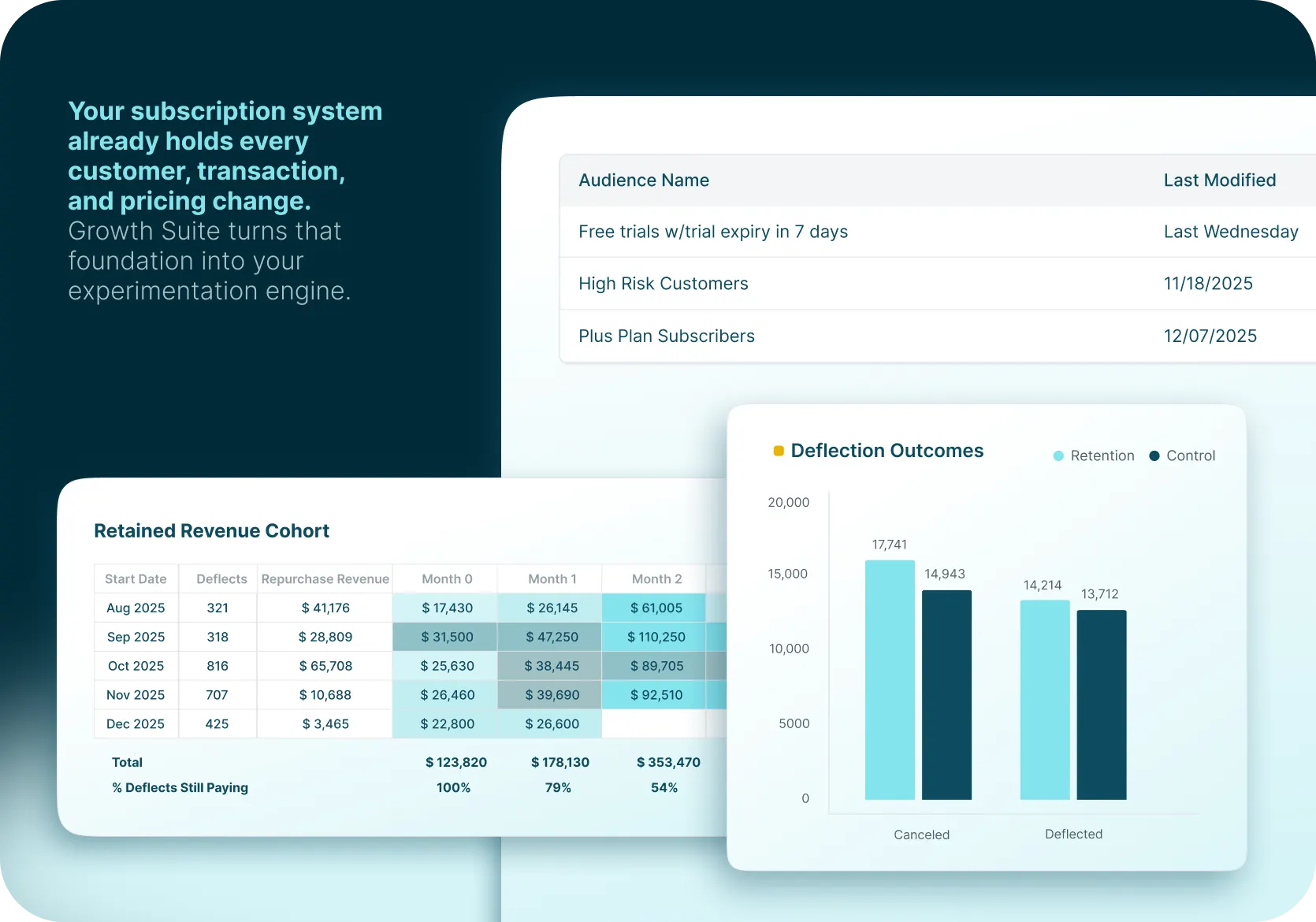
Chargebee Growth reporting shows customers engaged, revenue retained, and MRR impact for every Play, tied directly to Chargebee Billing events. That connection lets a team see an accepted offer as a subscription change rather than only an interaction, and weigh it against the discount given. Condé Nast, uses Chargebee Retention and treats each save as retained revenue that compounds. Its Senior Director of Product for Subscriptions says Chargebee Retention illustrates the impact on retained revenue, which grows exponentially.
Discounting erodes margin when it retains customers who would have stayed anyway or buys a save at a price above the revenue it protects. Reading offer cost against retained MRR exposes those cases, so a team can retire an offer that looks good on save rate but loses money in net terms. As TouchNote found, a 40% offer that matched a 50% offer on saves protected the margin the deeper discount would have surrendered.
Traditional retention is reactive, generic, and unmeasured. AI-driven retention is predictive, personalized, and measured in revenue.
The shift shows up at three moments, predicting churn, intervening at cancel, and recovering failed payments, plus how each result is measured. The table compares both approaches across those moments.
|
Capability |
Traditional retention |
AI-driven retention |
|---|---|---|
|
Predict churn |
Reactive; teams learn about churn at or after cancel |
Predictive; churn scores flag risk before the cancel click |
|
Intervene at cancel |
One generic offer for everyone |
Offer matched to each subscriber’s reason for leaving |
|
Recover failed payments |
Manual or basic retries |
Smart dunning with ML-optimized retries and account updater |
|
Measurement |
Clicks and engagement signals |
Retained revenue and MRR impact tied to billing events |
Chargebee Retention and the Chargebee Growth suite run these steps on billing-backed data.
Building a cancel flow in-house takes months and ships a generic flow with no AI model or experimentation layer to improve it. Building an AI-driven retention program on Chargebee brings prediction, intervention, recovery, and measurement into one connected system.
For Chargebee Billing customers at the right tier, Chargebee Retention is a use case within the Chargebee Growth suite, running on Chargebee Billing data. Growth is the suite; Retention is one use case within it. That shared data foundation is what lets an offer accepted in a cancel flow apply to the subscription in Billing in real time, with no manual handoff and no engineering ticket for routine changes.
We believe generic save offers leak revenue at the cancel moment, so teams need to test the right offer per reason to leave rather than ship one flow and hope. Building that in-house means sprint allocation the product roadmap can rarely spare, and every new region or brand adds risk to a hand-built flow. Chargebee Retention and Chargebee Growth turn the cancel flow into a live experiment on billing-backed data, so a billing system with subscription heritage now runs with AI-native agility. This matters as AI reshapes recurring revenue: 77% of subscription businesses cite AI as their number one technology investment, and 80% of companies adding AI to their products are also evolving pricing, with those aligning pricing to AI innovation nearly twice as likely to expect high growth.
AI-driven customer retention uses a model to predict which subscribers are likely to leave, then acts before they do. It works as a loop: predict churn from billing signals, intervene with an offer matched to the subscriber’s reason for leaving, and recover revenue from failed payments, keeping more of the right customers without discounting the ones who would have stayed.
AI reduces churn in three ways, all from the same billing data. It scores churn risk early so teams can act before the cancel click, it personalizes retention offers by reason instead of showing one discount to everyone, and it recovers involuntary churn from failed payments through smart dunning.
AI predicts churn with a scoring model trained on first-party billing data. Chargebee Growth AI Churn Scores use a personalized model built on each customer’s own data, drawing on 48 attributes across six categories and returning a score from 1 to 99. The score flags at-risk subscribers so a team can intervene before cancel intent turns into a cancellation.
The most effective techniques are smart retry logic that times each retry, account updater that refreshes expired cards automatically, and multi-step dunning sequences that escalate through reminders and alternative payment methods. Chargebee Receivables delivers these on top of Chargebee Billing. Because the customer intended to stay, recovering these payments returns revenue that would otherwise lapse.
AI-driven retention is predictive where traditional retention is reactive, personalized where traditional retention is generic, and measured in retained revenue where traditional retention counts clicks. It learns from every cancel attempt and ties each outcome to a billing event, so teams can prove which offers retain revenue.
Static save offers leak revenue at the exact moment of churn, because one discount cannot fit a Flight Risk, a price-sensitive subscriber, and a loyalist at the same time. Treating the cancel moment as an experiment turns that leak into a system that learns: predict risk early, match the offer to the reason, measure retained revenue, and recover failed payments before they lapse. See how Chargebee Retention and the Chargebee Growth suite turn the cancel moment into a measured experiment on billing-backed data.

