

Why the Growth Playbook Is Changing
The traditional SaaS growth path — start with SMBs, then gradually move upmarket — no longer fits every company. Many AI-native startups land enterprise deals from day one. Others blend product-led growth with sales-assisted motions from the outset.
What's changed is the pace. Legacy SaaS companies like Zendesk and Atlassian had a decade or more to reach $100 million in revenue. Today's fastest-growing AI startups are hitting that milestone in under two years. That acceleration leaves little room for trial and error. Operational maturity can't wait.
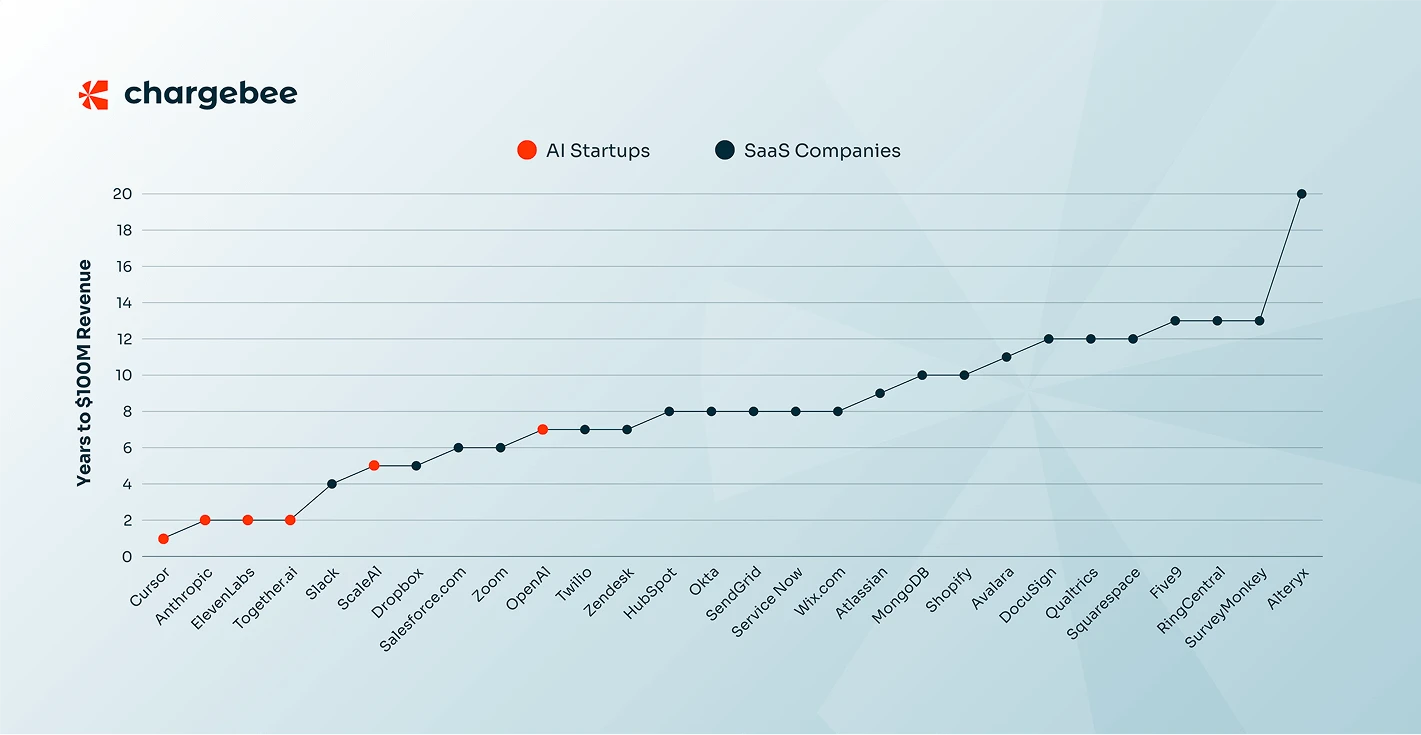
*The chart shows OpenAI at seven years, but we all know it took them far less time — ChatGPT launched in 2022, and by 2024, they were already at $3.7 billion in revenue.
No matter how growth begins, it quickly introduces complexity. Sales cycles stretch. Pricing becomes inconsistent. Internal tools and processes start to buckle. That's when RevOps becomes critical as the foundation for scale.
Enterprise growth demands process clarity, data integrity, and alignment across teams. RevOps delivers all three. It builds scalable workflows, ensures pricing and deal discipline, and provides leadership with visibility to act with confidence.
When signals of enterprise demand emerge — larger ACVs, longer buying cycles, more complex procurement — RevOps must move early. The groundwork you lay determines whether the business scales smoothly or stalls under pressure.
Building operational readiness and revenue discipline for enterprise growth
Selling to enterprises is not just about having a great product; it's about having the operational muscle to support complex sales cycles, high-value contracts, and multi-stakeholder relationships. Let's dive into the essential components of selling to enterprises and the pivotal role RevOps plays in this motion.
#1 Decoding the Signals — Is There Real Enterprise Demand?
One of the biggest mistakes SaaS companies make is pushing into enterprise sales without clear demand signals. Simply deciding to sell to enterprises isn't enough — there must be observable proof that enterprises want and need the product.
Before committing resources to enterprise sales, companies should validate demand by looking for key signals.
Validating Demand for Enterprise Sales
Inbound interest from large enterprises actively seeking a solution
Referrals from existing customers introducing the product to their enterprise peers
Organization-wide increase in adoption of the product, not just niche departmental needs
Enterprise sales should be driven by market pull, not internal ambition alone. If enterprises aren't already showing interest, forcing an enterprise strategy too soon can result in wasted time, money, and effort. Instead, companies should focus on nurturing and capitalizing on existing demand before scaling their enterprise efforts.
Once real demand is identified, the next step is ensuring the company is operationally ready to serve enterprise customers.
#2 Treat Your GTM System Like a Second Product
Enterprise customers offer larger deal sizes, longer contracts, and high-profile logos, making them a major growth opportunity for SaaS companies. But selling to enterprises is fundamentally different from selling to SMBs. It requires not only a great product but also a scalable, disciplined go-to-market (GTM) system that can handle long, complex sales cycles.
Many SaaS companies believe that hiring a few enterprise reps and adding security features is enough to succeed in enterprise sales. However, true success requires more than just a great product — it demands a scalable, repeatable GTM engine that enables efficient and predictable growth.
In fact, the most successful founders build two products at the same time:
- The product sold to customers
- The GTM system — a well-oiled machine that enables repeatable enterprise sales
Revenue Operations serves as the foundation of this GTM system. However, many early-stage companies shy away from investing in RevOps, fearing it will introduce unnecessary complexity. But neglecting RevOps is one of the quickest ways to derail enterprise sales. Without it, companies grapple with fragmented sales processes, inconsistent pricing, and poor pipeline visibility — fatal flaws when navigating complex enterprise deals.
#3 Build the Muscle to Power Enterprise Deals
Enterprise deals are longer, more complex, and involve multiple stakeholders across IT, finance, legal, and procurement. To manage this complexity, companies need structured processes — and that's where RevOps becomes a critical partner.
RevOps Enables Enterprise Sales in Three Key Ways
Stakeholder and Buyer Insights
Enterprise sales involve multiple decision-makers. RevOps helps sales teams map stakeholders and navigate procurement, security, and legal reviews.
Deal Structuring and Support
Large enterprise deals are complex. RevOps establishes a deal desk to ensure pricing discipline, approval workflows, and contract negotiations.
Sales Enablement and Training
Enterprise sales require expertise. RevOps provides playbooks, targeted training, and data-driven coaching to improve sales effectiveness.
Unlike SMB deals that close in weeks, enterprise deals can take 12–24 months. Because of these long cycles, early success is about tracking leading indicators such as:
- Executive-level conversations with key decision-makers.
- The quality and size of the pipeline, showing engagement from the right enterprise accounts.
- Advancements in pilot programs or proof-of-concept projects, which lead to full-scale deployments.
Companies that invest in RevOps early set themselves up for long-term success in enterprise sales. But beyond deal management, RevOps also plays a key role in enterprise pricing strategy.
So, how can SaaS companies successfully sell to enterprise customers? Let's break it down.
#4 Assess Your Enterprise Readiness
Successfully selling to enterprises goes beyond having a strong product. It requires a comprehensive assessment of organizational readiness across product, platform, partnerships, and sales to ensure smooth adoption and retention. Here is a checklist to assess your operational maturity to sell to enterprise customers.
1. Product Readiness
The foundation of enterprise readiness is ensuring your product addresses enterprise-wide problems. Large companies don't invest in software for narrow, isolated use cases — they seek platforms that solve critical, large-scale business challenges.
Does your product provide a solution at scale, addressing enterprise-wide needs?
Does it offer features essential to large organizations, such as advanced security, compliance, and configurability?
A great example of solving enterprise-wide problems at scale is Okta. Think of Okta as the go-to platform for securing user identities across all the systems, devices, and environments big companies rely on. It's like the command center for identity management — centralized, efficient, and fully compliant — while effortlessly integrating with the rest of an enterprise's tech stack.
2. Platform Interoperability & Extensibility
Enterprise buyers expect seamless integration with their existing tech stack and infrastructure. Without strong interoperability, deals can stall in procurement.
Is your platform scalable, secure, and compliant with enterprise requirements?
Does it support role-based access, audit logs, and seamless integrations with commonly used enterprise systems?
Can your platform easily extend or integrate with other tools through APIs or connectors?
3. Partnership Network
Enterprises often rely on implementation partners, system integrators, and consultants to deploy and customize software solutions. A strong partner ecosystem accelerates onboarding and fills service gaps.
Have you established partnerships with system integrators and consultants who can support large-scale deployments?
Is your partnership network equipped to handle enterprise-specific requirements such as compliance and data migration?
Microsoft is a textbook example of a strong Partnership Network. It is one of the largest and most influential ecosystems in the enterprise software world. Through the Microsoft Partner Network (MPN), Microsoft collaborates with a massive range of partners including system integrators, managed service providers, independent software vendors (ISVs), and resellers.
4. Sales Capability
Enterprise sales is complex and involves multi-stakeholder sales cycles, long procurement processes, and high-touch relationship management. This requires a skilled and specialized sales team.
Do you have experienced account executives, solution engineers, and customer success managers dedicated to enterprise sales?
Are your sales processes designed to manage longer sales cycles and complex procurement stages effectively?
A strong example of enterprise sales capability is ServiceNow. This high-touch model ensures that ServiceNow can navigate complex sales cycles involving multiple stakeholders across IT, finance, legal, and procurement.
5. RevOps as the Engine Behind Enterprise Sales
Scaling enterprise sales requires a robust RevOps system to power deal management, pricing strategy, and forecasting.
Have you established strong sales processes, data hygiene, and deal structuring frameworks?
Are you using AI-driven forecasting to predict revenue accurately and optimize sales motions?
Does your RevOps infrastructure support structured deal management, pricing discipline, and pipeline visibility?
HubSpot started as an SMB-focused company but has successfully expanded into enterprise sales by building a strong RevOps foundation very early on. They created a centralized RevOps team responsible for aligning sales, marketing, and customer success, which ensures consistency across the entire revenue process.
6. Designing Enterprise Pricing with RevOps
Enterprise pricing is not one-size-fits-all. It requires flexibility and strategic oversight to balance profitability with competitive pricing.
Are you analyzing win-loss data to refine pricing models?
Do you have discounting frameworks in place to prevent margin erosion?
Are you continuously optimizing pricing experiments (tiered, usage-based, value-based)?
A great example here is NextBillion.ai. They switched from pure usage-based pricing to a hybrid model with Chargebee, combining predictable subscriptions with scalable usage-based revenue. This move doubled their revenue, streamlined billing operations, and allowed the sales team to focus on high-value customers.
Finding Success
Selling to enterprise, apart from a great product, is about building a scalable GTM system that supports long sales cycles, large deal sizes, and complex buyer journeys. Success comes from:
- Solving enterprise-wide problems with a product that meets compliance and security needs.
- Building a sales and partner ecosystem that can manage long buying cycles.
- Investing in RevOps early to enable structured deal management, pricing discipline, and pipeline visibility.
Companies that approach enterprise sales with discipline, patience, and an operational mindset will not only close bigger deals — but build a foundation for long-term, scalable growth.
About Chargebee
Chargebee is the revenue growth platform built for scaling SaaS and subscription businesses. Over 6,500 companies — from fast-growing startups to global enterprises — use Chargebee to streamline quote-to-cash, support complex pricing models, and stay audit-ready without slowing down sales.
RevOps teams rely on Chargebee to automate billing, manage subscriptions, enforce pricing discipline, and unify finance and sales systems for greater visibility and control.
Make your upmarket move seamless.
Connect with us →